


Support the Next Generation of Research Leaders
The future of breast cancer research depends on the inspiring, committed, and innovative early-career researchers.
Your generosity enables researchers at critical stages in their careers to pursue groundbreaking, hypothesis-driven research. Together, we can unlock new knowledge about breast cancer, advance patient care, and improve outcomes for everyone affected by the disease.

Overcoming Immunotherapy Resistance in Triple Negative Breast Cancer
Meet Dr. Nguyen Long, M.D., Ph.D., a postdoctoral scholar at the University of Chicago dedicated to overcoming immunotherapy resistance in triple-negative breast cancer. His research explores the mechanisms behind treatment resistance and develops strategies to improve the effectiveness of immunotherapies. Dr. Long’s groundbreaking work is advancing innovative approaches to enhance outcomes for patients battling this aggressive disease.
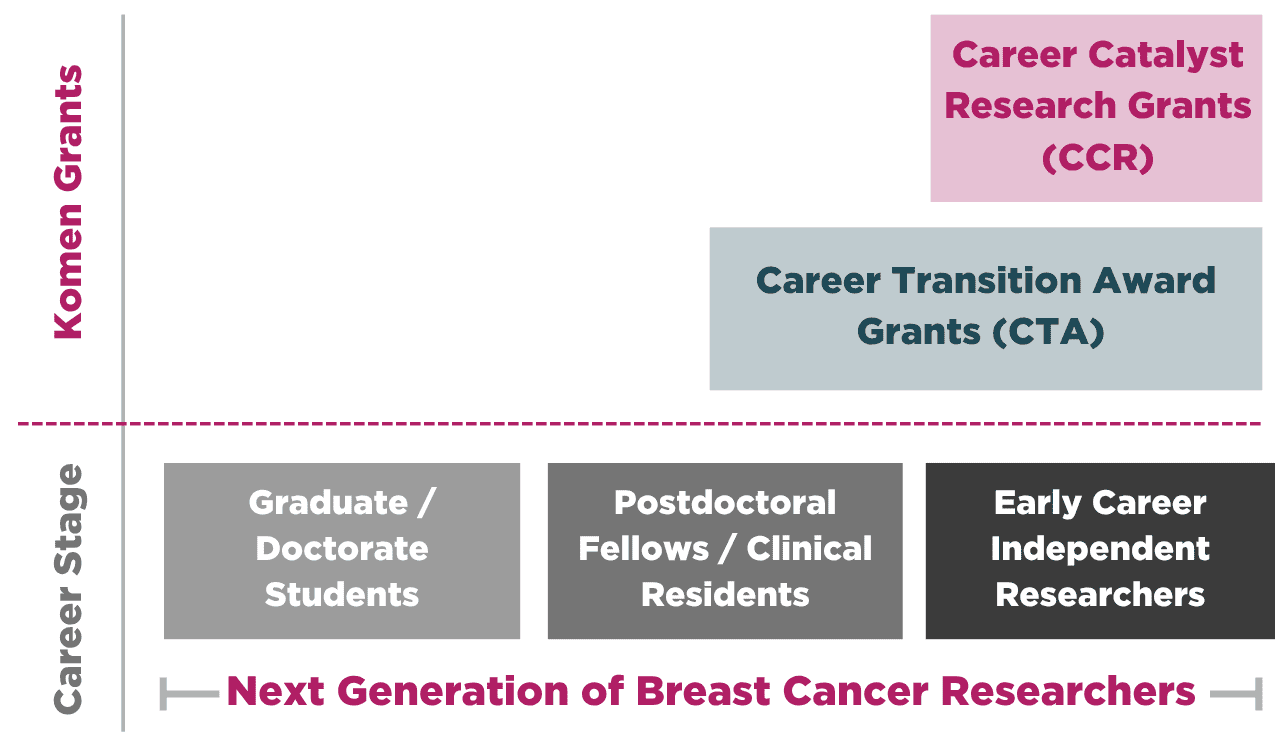
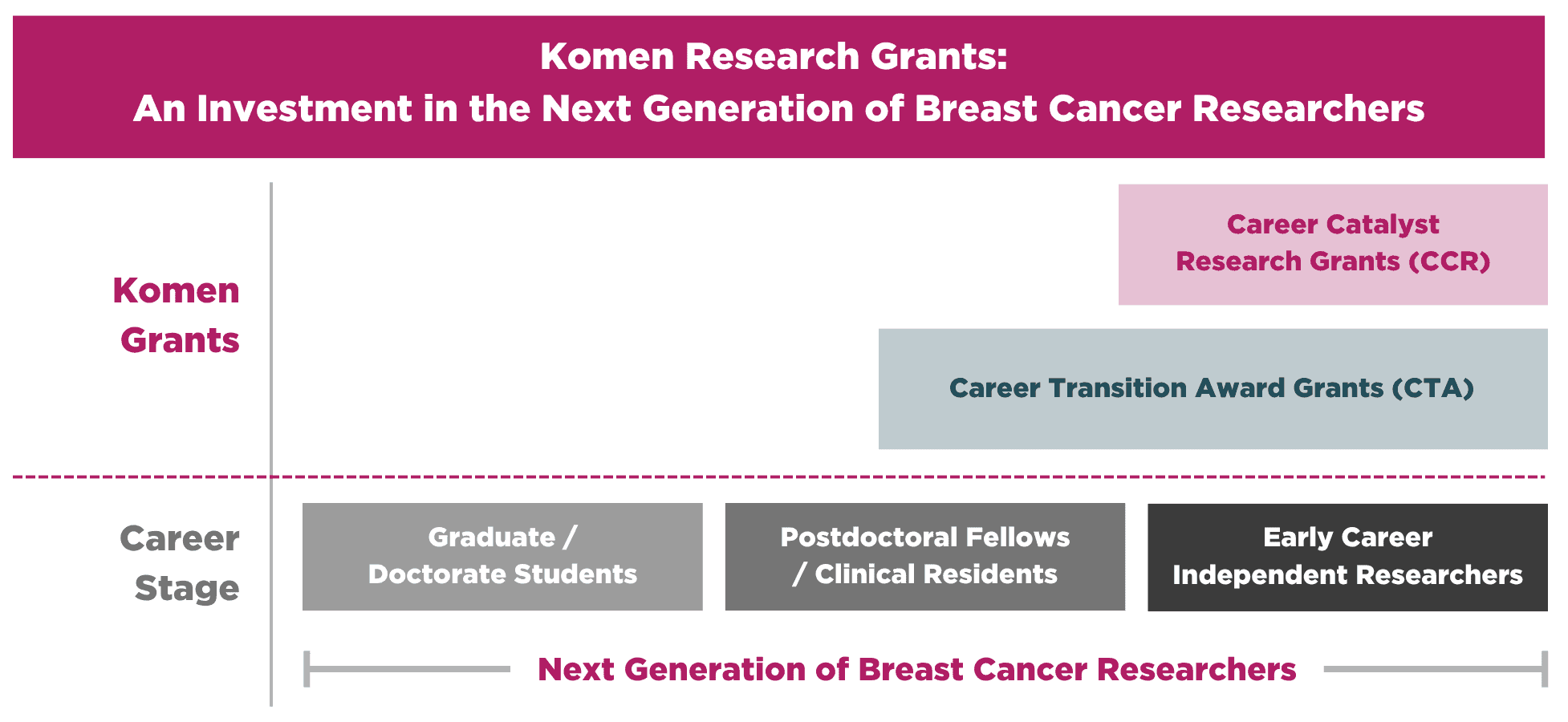
Komen Research Grants:
An Investment in the Next Generation of Breast Cancer Researchers
Komen Research Grants:
An Investment in the Next Generation of Breast Cancer Researchers
Meet Our Career Catalyst Research (CCR) Grantees
Career Catalyst Research (CCR) Grants support promising breast cancer researchers who are in the early stages of their independent, faculty careers for up to three years of “protected time” for conducting their hypothesis-driven research.
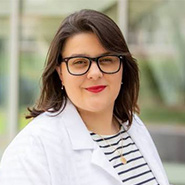
Targeting Dormancy Pathways to Prevent Breast Cancer Relapse
Julie Di Martino, Ph.D.
New York Medical College

Novel Therapies for Aggressive Basal-Like Breast Cancer
Carman Li, Ph.D.
University of Pennsylvania Perelman School of Medicine
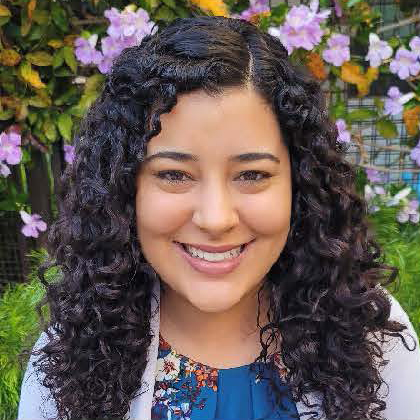
Overcoming Drug Resistance in Bone Metastatic Breast Cancer
Eva González Díaz, Ph.D.
Icahn School of Medicine at Mount Sinai

Next-Generation Vaccines for Triple Negative Breast Cancer
Anli Zhang, Ph.D.
UT Southwestern Medical Center

Personalized Treatment Strategies for High-Risk Breast Cancer
Rosalyn Sayaman, Ph.D.
The Regents of the University of California, San Francisco

Immune-Activating Therapy for HER2+ Metastatic Breast Cancer
Benjamin Schrank, M.D., Ph.D.
The University of Texas MD Anderson Cancer Center
Meet Other Career Catalyst Research (CCR) Grantees

Novel Therapy to Inhibit DNA Repair Mechanisms and Prevent Tumor Cell Division in Ethnically Diverse Breast Cancer
Nathan Merrill, Ph.D.
University of Michigan

Seeking New Immunotherapy Benefits for Obese Women with TNBC
Erika Crosby, Ph.D.
Duke University

Eliminating Metastasis Potential by Promoting Breast Cancer Dormancy via Macrophages
Lucia Borriello, Ph.D.
Temple University

Closing the Gap: Mixed Methods Approaches to Reducing Breast Cancer Disparities
Anand Narayan, M.D., Ph.D.
University of Wisconsin-Madison

Holistic Decision-Making Framework for Personalized Breast Cancer Screening
Bruno Barufaldi, Ph.D.
University of Pennsylvania

Using Natural Killer Cells to Treat Metastatic Breast Cancer
Isaac Chan, M.D., Ph.D.
University of Texas Southwestern Medical Center

Deep Learning Mammographic Evaluations to Refine Breast Cancer Risk
Julia McGuinness, M.D.
Columbia University

Using AI-Based Methods on Medical Imaging to Predict Breast Cancer Risk in Black Women
Aimilia Gastounioti, Ph.D.
Washington University in St. Louis

Examining Immune Mechanisms of Margetuximab vs Trastuzumab in HER2+ Breast Cancer
Adrienne Waks, M.D.
Dana-Farber Cancer Institute

Targeting Dysfunctional DNA Replication Origin Control in Breast Cancer
Sarah Hill, M.D., Ph.D.
Dana-Farber Cancer Institute

Targeting GPR84 to Overcome Resistance to Immunotherapy
Gang Xin, Ph.D.
The Ohio State University

A New Chromatin-Directed Vulnerability in BRCA-Mutant Breast Cancers
Priyanka Verma, Ph.D.
Washington University in St. Louis

Biomarkers of Racially Disparate Drug Response in Triple Negative Breast Cancer
Sheheryar Kabraji, BM BCh
Roswell Park Alliance Foundation

Navigator-Assisted Hypofractionation (NAVAH) Short-Course Radiation Therapy in Black Breast Cancer Patients
Shearwood McClelland III, M.D.
University Hospitals Cleveland Medical Center

Using Special RNA Targets to Develop a Breast Cancer Vaccine
Chun-Kan Chen, Ph.D.
Washington University in St. Louis

Enhancing Natural Killer Cell Activity Against Triple Negative Breast Cancer
Miriam Jacobs, M.D.
Georgetown University
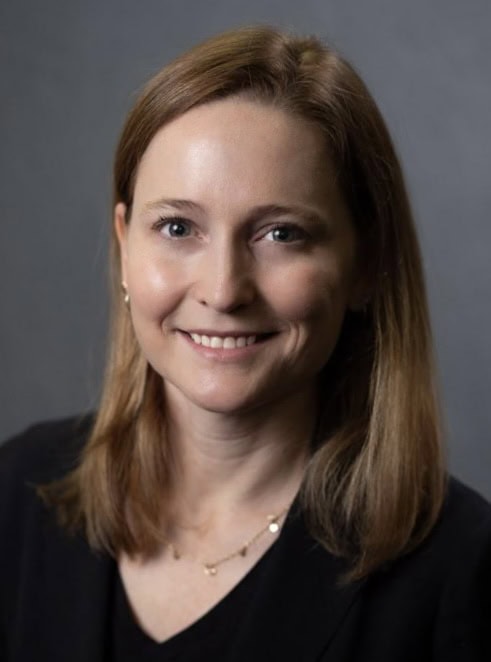
Prospective Study of Employment-Related Outcomes in Metastatic Breast Cancer
Claire Sathe, M.D., J.D.
Columbia University Irving Medical Center

Understanding the Impact of Suppressive Myeloid Cells on Breast Cancer Progression
Martina Molgora, Ph.D.
H. Lee Moffitt Cancer Center & Research Institute, Inc.

Implementing Home-Based Screening Clinical Breast Examination in South Africa
Daniel O’Neil, M.D., M.P.H.
Yale University

Targeting eIF4A to Combat Metastatic Triple Negative Breast Cancer
Na Zhao, Ph.D.
Baylor College of Medicine
Meet Recent Leadership Grantees
Leadership Grants are prestigious, invitation-only awards that provide funding to Komen Chief Scientific Advisors, Scientific Advisory Board members, and Komen Scholars for innovative, hypothesis-driven research aligned with Komen’s mission to prevent and cure breast cancer.
Identifying Young Women at High Risk for Breast Cancer
Kornelia Polyak, M.D., Ph.D.
Dana-Farber Cancer Institute
Precision Therapies for Luminal Androgen Receptor TNBC
Jennifer Pietenpol, Ph.D.
Vanderbilt University Medical Center
Improving Quality of Life for Latina Breast Cancer Survivors
Amelie Ramirez, Dr.P.H.
The University of Texas Health Science Center at San Antonio
Liquid Biopsy-Guided Personalized HER2+ Treatment
Ian Krop, M.D., Ph.D.
Yale School of Medicine
Reducing Disparities in Triple Negative Breast Cancer
Lisa Newman, M.D., M.P.H.
Weill Cornell Medicine
Targeting SF3B1 Mutations in Breast Cancer
Ben Ho Park, M.D., Ph.D.
Vanderbilt University Medical Center
Understanding Immune Drivers of Racial Breast Cancer Disparities
Melissa Troester, Ph.D.
University of North Carolina at Chapel Hill
Predicting Treatment Response Through Tumor Microenvironment Analysis
Christina Curtis, Ph.D.
Stanford University School of Medicine
Weight Loss Medications for Breast Cancer Prevention
Rulla Tamimi, Sc.D., M.S.
Weill Cornell Medicine
Expanding Genetic Counseling for Young Black Women
Tuya Pal, M.D.
Vanderbilt University Medical Center
Personalizing Radiation Therapy for Better Outcomes
Reshma Jagsi, M.D., D.Phil.
Emory University
Understanding Drivers of Breast Cancer Mortality
Allison Kurian, M.D., M.Sc.
Stanford University School of Medicine
Overcoming Endocrine Therapy Resistance
Cynthia Ma, M.D., Ph.D.
Washington University in St. Louis
Optimizing Immunotherapy for Metastatic TNBC
Sara Tolaney, M.D., M.P.H.
Dana-Farber Cancer Institute
Targeting LYPD3 Across Breast Cancer Subtypes
Donald McDonnell, Ph.D.
Duke University
Improving Decision-Making for BRCA Mutation Carriers
Susan Domchek, M.D.
University of Pennsylvania
Expanding the Reach of Breast Cancer Immunotherapy
Lisa Coussens, Ph.D.
Oregon Health & Science University
New Treatment Targets for Breast Cancer Brain Metastases
Nancy Lin, M.D.
Dana-Farber Cancer Institute
AI-Driven Expansion of Hereditary Cancer Testing
Tracy Battaglia, M.D., M.P.H.
Yale University
Understanding Resistance to HER2-Targeted ADCs
Sohrab Shah, Ph.D.
Memorial Sloan Kettering Cancer Center
Addressing Social Barriers to Breast Cancer Care
Mariana Chavez MacGregor, M.D., M.Sc.
The University of Texas MD Anderson Cancer Center
Meet Our Career Transition Award (CTA) Grantees
Career Transition Awards provide up to five years of funding in two phases: Phase 1 supports the final years of mentored, postdoctoral training and Phase 2 supports the independent research of the early career, tenure-track investigators.

Advanced Detection of Chemotherapy Resistance and Metastatic Risk
Julia Ransohoff, M.D.
Stanford University School of Medicine

Biomarker-Guided ADC Therapy for Metastatic Breast Cancer
Daniel Peiffer, M.D., Ph.D.
The University of Chicago

New Targeted Therapies for Estrogen Receptor-Positive Breast Cancer
Hanna Karvonen, Ph.D.
NYU Grossman School of Medicine
Meet Other Career Transition Award (CTA) Grantees

Physical Activity to Reduce Breast Cancer Treatment Morbidity
Moriah Bellissimo, Ph.D.
Virginia Commonwealth University

Evaluating Germline Genetics and Tumor Genomics of Young-Onset Breast Cancer
Kristen Brantley, Ph.D.
Dana-Farber Cancer Institute

Ceramide Actions in Endocrine Therapy-Resistant Breast Cancer Models
Douglas B. Fox, Ph.D.
Massachusetts General Hospital

Overcoming Immunotherapy Resistance in Triple Negative Breast Cancer
Long Chi Nguyen, M.D., Ph.D.
The University of Chicago

Ceramide Actions in Endocrine Therapy-Resistant Breast Cancer Models
Purab Pal, Ph.D.
University of Illinois at Chicago

Targeting Fusion RNAs in Metastatic Breast Cancer
Nolan Priedigkeit, M.D., Ph.D.
Dana-Farber Cancer Institute

Microbial-inspired Strategy to Enhance Breast Cancer Immunotherapy
Yifan Wang, Ph.D.
University of Texas M.D. Anderson Cancer Center

Topological Heterogeneity of Breast Cancer Brain Metastases
Jun Nishida, Ph.D.
Dana-Farber Cancer Institute

Hyperactivating the Androgen Receptor in Triple Negative Breast Cancer
Charles Dai, M.D.
Massachusetts General Hospital

Characterizing Mutational Processes Driving Therapy Resistance in Breast Cancer
Avantika Gupta, Ph.D.
Memorial Sloan-Kettering Cancer Center
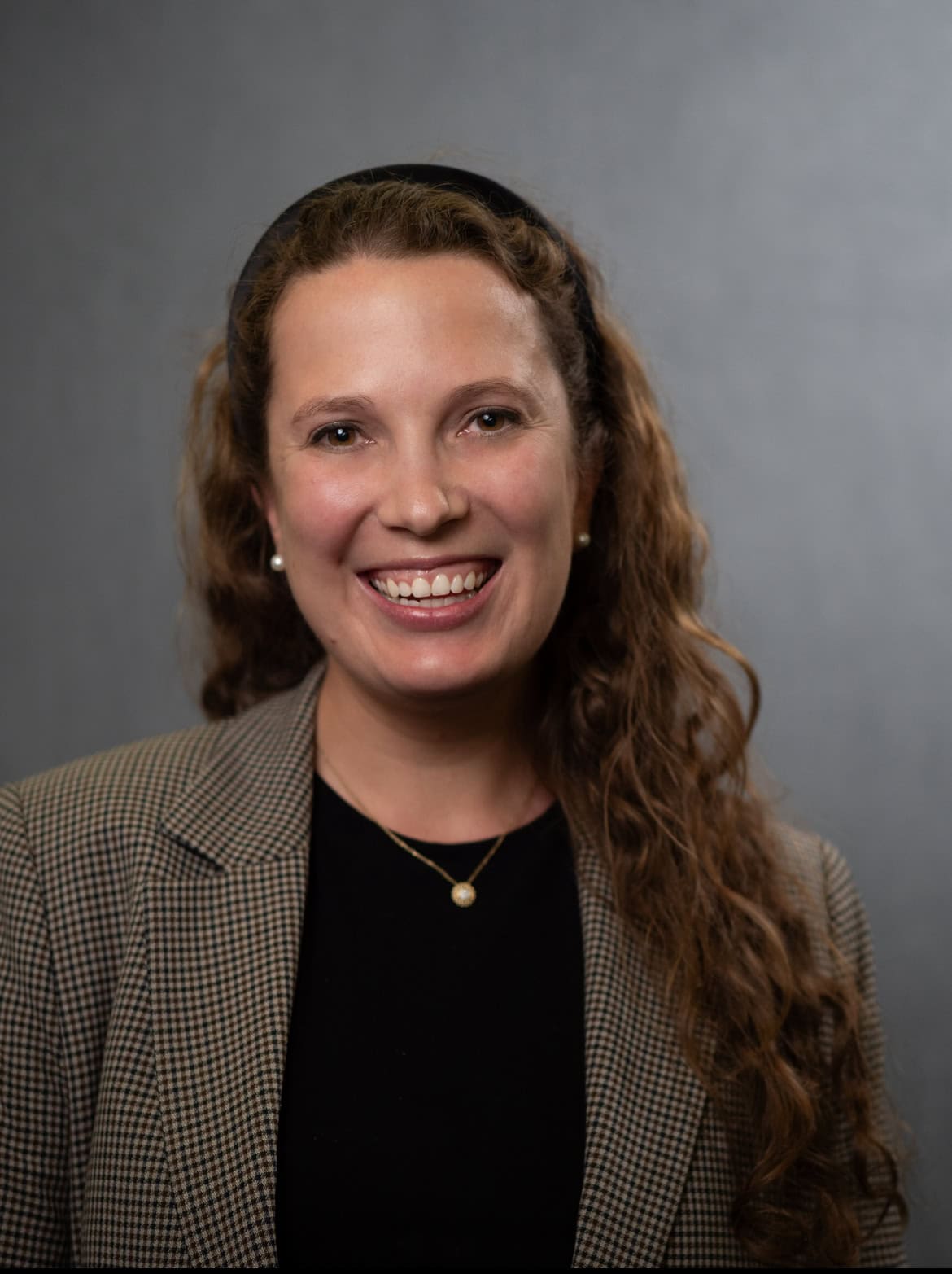
Decision Support for Enhanced Breast MRI Screening in High-Risk Women
Alissa Michel, M.D.
Columbia University Irving Medical Center

Mechanisms of Peripheral Nerve Co-option in Breast Cancer Metastasis
Veena Padmanaban, Ph.D.
The Rockefeller University

Targeting the Tumor-Stroma Interactions in Breast Cancer Brain Metastasis
Siting Gan, Ph.D.
Memorial Sloan Kettering Cancer Center
Komen CTA Grantee Dr. Kristen Brantley is Improving Breast Cancer Outcomes for Young Women
Dr. Kristen Brantley, Ph.D., is a Komen-funded researcher at the Dana-Farber Cancer Institute focused on improving breast cancer outcomes for young women. Her work explores how genetic and tumor-related factors contribute to more aggressive disease and poorer outcomes in patients under 40, a group often underrepresented in research. By uncovering the biological drivers of young-onset breast cancer, Dr. Brantley aims to advance early detection and develop more targeted, effective treatment strategies.

Recipients of Opportunity Grants
The Susan G. Komen Opportunity Grants are prominent medical investigators and consortia leading breast cancer research and clinical trials

Accelerating Metastatic Breast Cancer Clinical Trials
Antonio Wolff, M.D.
Johns Hopkins University School of Medicine

Preventing Metastatic Relapse in Invasive Lobular Breast Cancer
Patrick Derksen, Ph.D.
University Medical Center Utrecht

AI-Driven Prediction of Metastatic Relapse in Lobular Breast Cancer
Christina Curtis, Ph.D.
Stanford University School of Medicine
Meet Recent Scientific Strategy & Programs Grantees
Scientific Strategy & Programs Grants support promising breast cancer researchers.

Developing the Next Generation of Global Oncology Researchers
Kate Quinn, CFRE
American Society of Clinical Oncology

Advancing Research and Awareness for Lobular Breast Cancer
Rita Mukhtar, M.D.
The Regents of the University of California, San Francisco

Accelerating Global Collaboration in Metastasis Research
Alana Welm, Ph.D.
Metastasis Research Society

ASPIRE Grantee Dr. Zannel Blanchard: Patient Derived Models to Understand Tumor Evolution in Response to Therapy
Mentored by Dr. Alana Welm
Under the mentorship of Alana Welm, Ph.D., at the University of Utah, postdoctoral fellow Zannel Blanchard, Ph.D., is investigating how breast cancer evolves in response to treatment. This research aims to identify factors that contribute to treatment resistance, providing critical insights to improve therapeutic strategies for breast cancer patients.
More information and grant naming opportunities please contact:
Trish Davis, CFRE
VP, Strategic Philanthropy
tdavis@komen.org | (972) 701-2171
Susan G. Komen
Attn: Next Gen. Research
13770 Noel Rd. | Suite 801889 | Dallas, TX 75380
Susan G. Komen’s federal tax identification number is 75-1835298.

ASPIRE Alumni
(A Supplement to Promote Inclusion for Research Excellence)
ASPIRE grants were intended to enhance the diversity of the breast cancer research workforce by providing established breast cancer scientists with supplemental funding to support research trainees from communities historically minoritized and marginalized in research.

Targeting ZFP296 to Prevent Reactivation of Dormant Metastatic Breast Cancer Cells
Carolina Rodriguez Tirado, Ph.D.
Albert Einstein College of Medicine

Effects of Chronic Social Stress on Mammary Gland Development and Cancer Risk
Briana Banks, Ph.D.
The University of Chicago

Mechanical Regulation of Estrogen Signaling in Breast Cancer Bone Metastasis
Logan Northcutt, Ph.D.
Vanderbilt University

Alcohol as a Dietary Factor for Breast Cancer
Kelsey Salcido
University of Pennsylvania

Targeting Druggable Protein Modifications in HR+ Breast Cancer
Kacie Waiters, Ph.D.
University of Houston

Evaluation of Steroidal Natural Compounds for the Treatment of Inflammatory Breast Cancer
Luz Arroyo-Cruz, Ph.D.
University of Puerto Rico

Progesterone Promotes an Immune Privileged Microenvironment in Breast Cancer
Harmony Saunders
The University of Kansas

Oxygen Tension – Dependent Changes in Breast Cancer and Drug Sensitivity
Adedeji Kolawole Adebayo
Winship Cancer Institute

Targeting Tumor-Associated Macrophage Heterogeneity to Treat TNBC
Alex Smith
Baylor College of Medicine

Targeted Therapeutics for Triple Negative Breast Cancer
Ailed Cruz-Collazo, Ph.D.
University of Puerto Rico, Medical Sciences Campus

SIM2 Regulation of Metabolism and Progression in ER+ Breast Cancer
Hannah Carter
Texas A&M AgriLife Research

PREPARE: Preparing Hispanic Advanced Breast Cancer Dyads for End-of-Life Care
Lianel Rosario
Ponce Medical School Foundation, Inc., PR

Investigating the Impact of Immune and Brain Cells Communication on Brain Metastasis
Aìlen Garcia-Santillan
Virginia Commonwealth University

Deimplementation of Preference-Sensitive Low Value Breast Cancer Care
Faith Dickerson, M.D.
University of Wisconsin-Madison

Image-Driven Breast Cancer Risk Assessment and Racial Disparities
Juanita Hernandez, Ph.D
Washington University in St. Louis

Role of Immunosuppressive T cells in Progesterone-Promoted Breast Cancer
Julio Tinoco
University of Kansas Medical Center Research Institute, Inc.

Retrograde Signaling of Mitochondrial tRNAs Suppresses Breast Cancer Progression
King Faisal Yambire, Ph.D.
The Rockefeller University

Patient Derived Models to Understand Tumor Evolution in Response to Therapy
Zannel Blanchard, Ph.D.
The University of Utah

Background Parenchymal Enhancement as a Biomarker of Breast Cancer Risk in Black Women
Mattia Mah’Moud
University of Pennsylvania

Modeling Chromosomal Abnormalities in Triple-Negative Breast Cancer
Catalina Alvarez Yela
University of Virginia

Neighborhood Disadvantage, Tumor Characteristics, and Breast Cancer Survival in U.S. Black Women
Etienne Holder, Ph.D.
Boston University

Deciphering Cancer Metabolism in Skeletal Metastases of Breast Cancer
Cheyenne Ernst
Roswell Park Alliance Foundation

Targeting Antigen Presentation to Improve Immunotherapy Response
Brandie Taylor, Ph.D.
Vanderbilt University

Targeting Metabolism to Enhance immunotherapy in Advanced Breast Cancer
Carlos Wanderley, Ph.D.
Brigham and Women’s Hospital

Uncovering Drivers of Organ Specific Breast Cancer Metastasis
Jesus Garcia-Lerena
Michigan State University

Activating Natural Killer Cells to Treat Breast Cancer
Isabella Terrazas
The University of Texas Southwestern Medical Center