
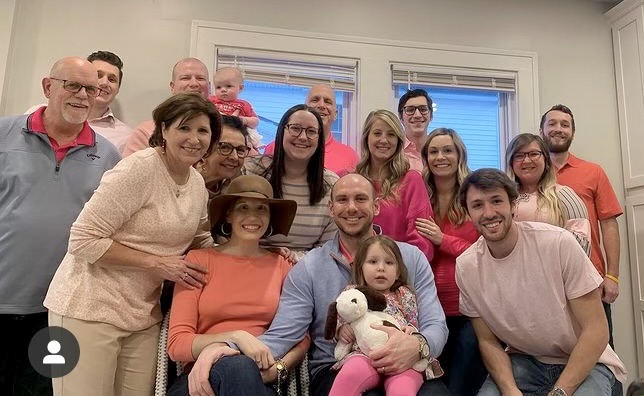
Alex’s family has an extensive family history of breast cancer. Her paternal grandmother had treatment for breast cancer twice; one of her paternal aunts was diagnosed with the disease when Alex was in her 20s; and Alex’s mom also had breast cancer.
“Even with all the breast cancer in my family, I still never imagined it would happen to me at 32,” Alex said. “I thought I’d face this in my 40s or 50s, never as a young mom with a 2-year-old.”
A Mother’s Diagnosis & Genetic Testing
Alex’s mom was diagnosed with early-stage breast cancer and had genetic testing. When her test came back negative for having a BRCA inherited gene mutation, Alex felt a wave of relief when the doctors suggested that because her mom did not carry the mutation, Alex likely didn’t either.
“Around that time, I found a lump in my breast, but tests showed it was a benign cyst,” Alex said. “At the time I didn’t advocate for close monitoring and neither did the doctor.”
Even though Alex’s mom tested negative for a genetic mutation, the thought that both sides of her family now had breast cancer loomed over her. “But because my mother was negative, when evaluating my risk, people always said, let’s start with your mother, and she’s negative, so it’s probably not something you need to worry about,” said Alex.
A Breast Cancer Diagnosis
Seven years later, when Alex was 32, she felt another lump in her breast. “I assumed it was another benign cyst,” she explained. She told her mother, who works in health care, and her aunt, a breast cancer patient navigator. Given the family history, they urged her have it checked out.
Alex had a diagnostic mammogram that quickly led to a biopsy. The radiologist told Alex that what she saw did not look great. “Sure enough, two days later, she called and said it was breast cancer,” said Alex. “Everything that I previously thought about my risk or when I could potentially get breast cancer was gone.”
Grappling with the Diagnosis
Alex was diagnosed with stage 2A invasive ductal carcinoma with lymph node involvement. “Despite being aware of my risk, everyone in my family who had breast cancer was post-menopausal when they were diagnosed. I was young. I hada 2-year-old daughter. I was healthy,” Alex said. “It was a big shock. It still is. I really thought that if it was going to happen, there was no way it would until I was older.”

Genetic Testing Leads to Surprising Results
A whirlwind of appointments followed Alex’s diagnosis, including genetic testing which showed she was positive for the BRCA2 inherited gene mutation. “When those results came back, I was crushed. I thought what if I had known sooner, could all of this have looked different?” she said. “Finding out I was positive felt like someone rewrote my past and my future overnight.”
Alex’s dad underwent genetic testing, too, and learned he was also positive for the BRCA2 inherited gene mutation. He also learned he had early-stage prostate cancer. However, he and Alex’s mom would keep the news from her and her siblings until she was finished with her treatment.
“Learning that my dad had been diagnosed with prostate cancer while I was going through treatment stopped me in my tracks,” said Alex. “He was protecting me the best way he knew how, even while he was fighting his own cancer.”
Alex’s four younger brothers began to seek out testing. Recently, her youngest brother learned he was positive for the BRCA2 inherited gene mutation. “It was a blow for all of us, but now he has the information he needs to be proactive about his risks,” Alex said.

Treatment Difficulties
Treatment for Alex was anything but smooth. “I thought breast cancer treatment would be a checklist: surgery, chemo, radiation. But the setbacks kept knocking me backwards,” she said.
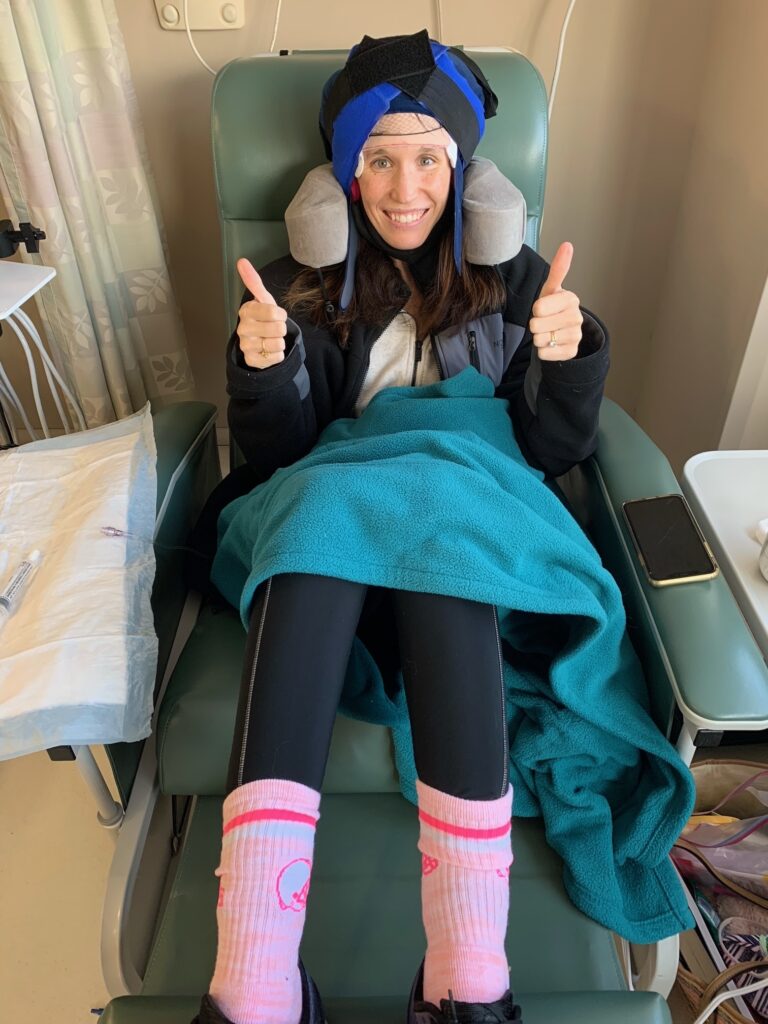
Alex had a double mastectomy and chemotherapy, then began radiation, which caused severe skin breakdown over her tissue expanders. They had to be removed, after which Alex spent three months in hyperbaric oxygen therapy. “It was one of the hardest parts. Four hours a day, five days a week, lying in a tube. I wondered how this became my life at 32,” Alex recalled. “But it allowed me to safely move forward with breast reconstruction.”
Fertility Preservation
Alex is the oldest of five kids. She and her husband dreamed of having a large family, but the realities of her breast cancer diagnosis cast a cloud over their plans.
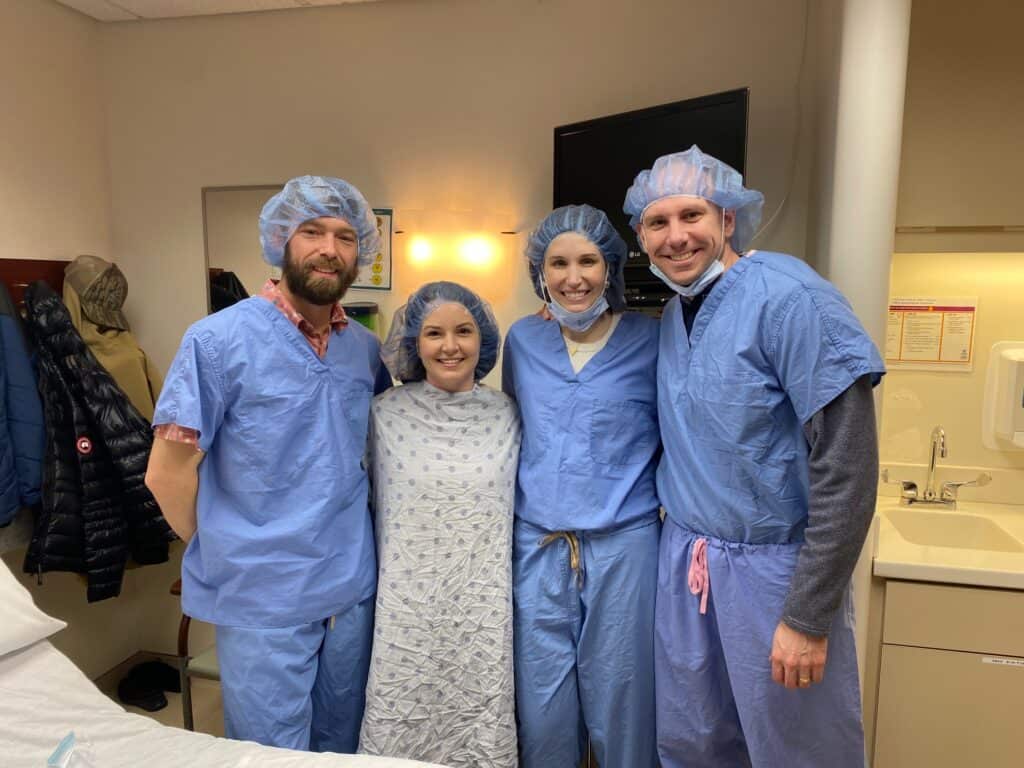
However, during the early stages of Alex’s treatment, her care team had urged her to pursue fertility preservation. This gave her a glimmer of hope for life after cancer. With only a small window before chemotherapy, she completed an accelerated round of IVF in just a week. “The thought of surrogacy became a light at the end of a very long tunnel,” said Alex. “It was proof that life after cancer was still possible.”
Surrogacy and the Future
Alex and her husband were ultimately matched with a woman whose own sister had passed away from breast cancer. “When we were matched with our carrier, it felt like fate,” Alex said. “It was as if her sister’s story and mine collided in this beautiful, unexpected way.”
Earlier this fall, Alex, her husband and their daughter welcomed a baby girl into their family. “I want my children to have what I had growing up, a built-in support system for their siblings. That dream kept me going on the darkest days,” she said.
Advocating for Her Future – and Her Daughters
Now finished with treatment, Alex focuses on living a healthy life – exercising, eating well and being there for her family. “I still navigate the anxiety many survivors know well,” she said. “Every ache can trigger a fear, but you have to choose to live fully.” Alex has undergone an oophorectomy and will have a full hysterectomy by the time she turns 40, to help reduce the risk of developing other cancers.
“I’m sharing my story for my daughters,” said Alex. “If they ever face this, I want them to know they’re not alone and they’re not powerless. You can’t change what wasn’t known, but you can use that knowledge to protect the next generation.”
BRCA1/2 Inherited Gene Mutations
Everyone has BRCA1 and BRCA2 genes. Some people have an inherited mutation in one or both of these genes that increases the risk of breast cancer. BRCA1/2 inherited gene mutations can be passed to you from either parent. They increase the risk of cancers in both women and men.
Statements and opinions expressed are those of the individual and do not express the views or opinions of Susan G. Komen. This information is being provided for educational purposes only and is not to be construed as medical advice. Persons with breast cancer should consult their health care provider with specific questions or concerns about their treatment.