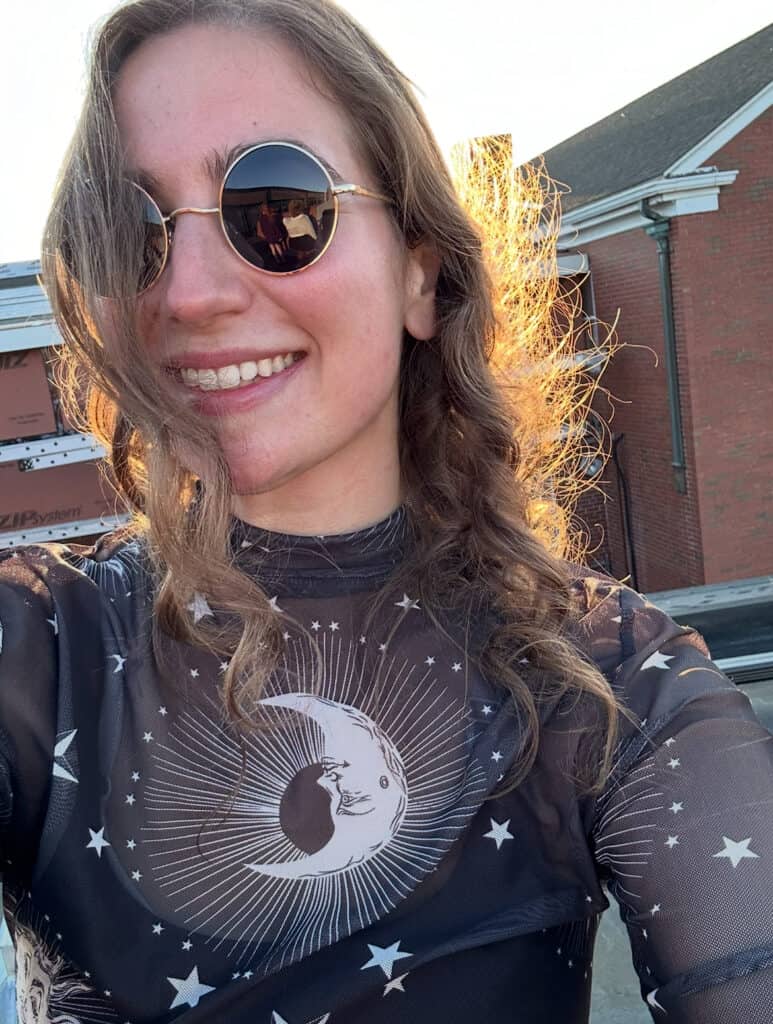
Caroline McNally was 30 when she was diagnosed with stage 3 breast cancer in October 2025. This is her story in her own words.
Imagine you’re at a gathering with your closest friends. Life is great! You’re standing in a group of people, drink in hand, relaxing and enjoying the company of your people. You are living and fully enjoying the moment.
But then, some loser throws a bucket of ice water on you and you’re just…standing there. In shocked, confused, utterly irate silence. You freeze on the spot and your conversation gets completely derailed and forgotten.
That’s what stage 3 breast cancer at 30 feels like.
A Sudden Shift
It’s such a sudden shift from what you think you know about your life. Suddenly, the routines you’ve curated and the true efforts you’ve put in to maintain your health seem laughably futile. The oddly comforting monotony of a 9-5 job or regular time spent with friends feels disorienting. Colors are too bright. Sounds are too loud. You feel like the gentle breeze on a bright, beautiful day is taunting you.
Discovering a Lump
The way my breast cancer journey started mirrors to so many other stories. It was a normal night. The TV was on and I was on the phone with my sister. My hands were cold, so I put them under my arms to warm them and that’s when I felt the lump under my palm. Given my age, I was hoping breast cancer was off the table. But when a long, dark hair started growing out of that lump and when the skin around it turned grey and bruised within three days of me first noticing it, I knew something was definitely wrong.
Next Steps
I was scheduled to have a diagnostic mammogram a month out, but my gynecologist and I knew this was something that couldn’t wait, and I am forever grateful that she did not dismiss me because of my age. She called in a favor at the nearby Women’s Health Center. With the efforts of my amazing medical team, it was exactly four weeks to the day between me first noticing the mass and a game plan was implemented to beat it completely.
Young Women Get Breast Cancer, Too
Of course, people ask me all the time, “How did this happen to you so young?” The fact is everyone is at risk of breast cancer. Although breast cancer is more common in older women, young women under 40 are still being diagnosed. About 4% of all breast cancer cases in the U.S. occur in women under 40 each year. And we know women under 40 are more likely to be diagnosed at later stages with more aggressive breast cancers than older women.
Through this experience, I’ve become acutely aware of the enormous gap between how cancer is discussed and how it is actually lived, especially for young women. Breast cancer is still framed as a disease of older age, something that happens “later.” That narrative is no longer accurate, and it is actively dangerous. It delays diagnoses, teaches young women to dismiss their instincts, it teaches providers to do the same. How many young women will die before something changes?
Me, Now
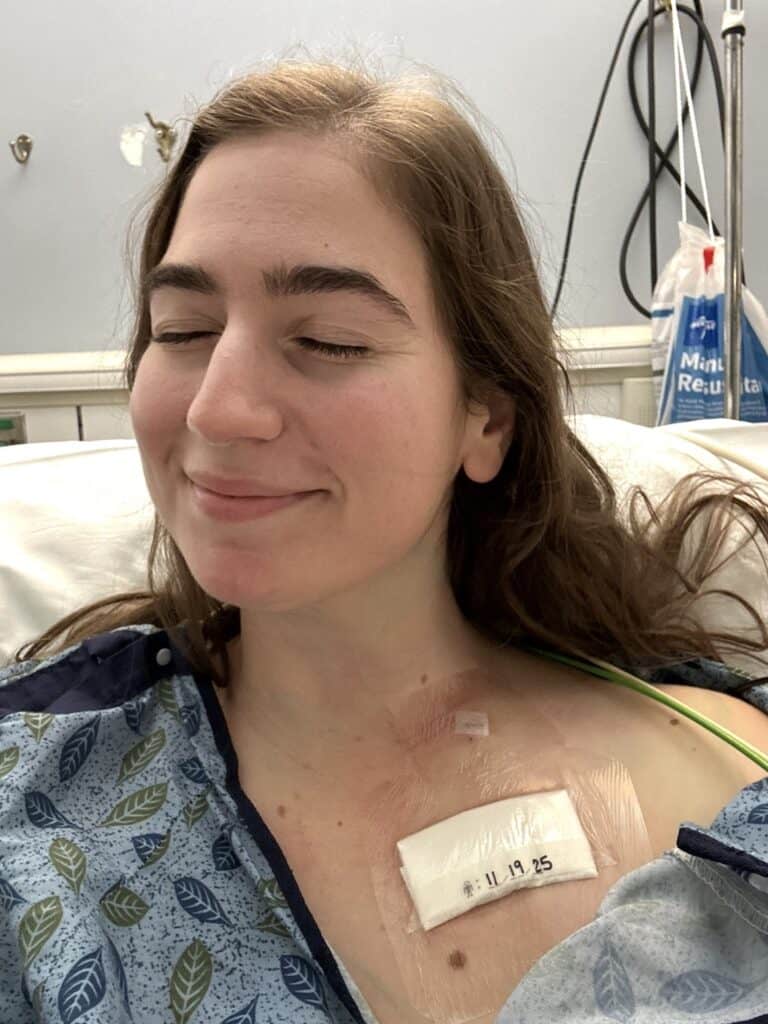
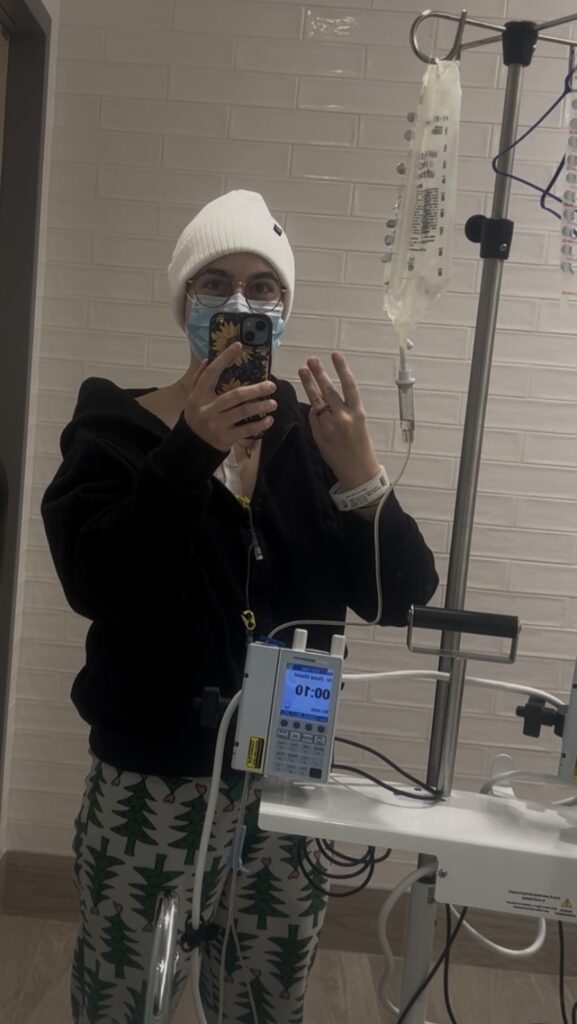
So here I am now, in the thick of it, undergoing chemo and the loss of who I was before all this happened. My fertility, my routines, everything right down to my hair and fingernails. I do not recognize myself in the mirror or in how my body is behaving at all, most days.
My treatment started with dose-dense AC (Adriamycin and Cytoxan). The side effects were ridiculous. I had mouth sores, migraines and infections, as well as roaring bone pain from the Neulasta shot to stimulate my white blood cell count.
I’m also in menopause forever now because of the hormonal-positive component of my cancer. It has been an enormous challenge trying to figure out all the rapid changes – my clothes fitting differently, hot flashes, mood shifts and not being able to sleep. The last few months have been a crash course in learning how to just manage when you have no other option, if I’m being honest.
Now I’m on Taxol now and it’s going far better, than the AC, which I’m thrilled about. After chemo, I’ll have a double mastectomy in the spring, probably followed by radiation, then hormone therapy. It’s a long road ahead, but the road will have a good ending for me – and I am so grateful for that every single day.
Learning to Advocate, for Myself & Others
Despite all of this madness, something larger is forming in me. If advocacy means anything, it means refusing to let silence persist just because the truth is uncomfortable. It means demanding better education, earlier attention to symptoms and a cultural shift that trusts women when they say something is wrong. It means supporting research into why this is happening and ensuring that young patients are not treated as outliers, but as a growing and urgent population.
Continuing Forward
Some days, surviving looks like strength. Other days, it looks like getting out of bed and brushing your teeth. Both count. I’m sharing my story not because I’ve finished this journey, but because I’m in it — and because awareness shouldn’t come only after you’re already standing there, mentally soaked, stunned and wondering how everything changed so fast. If being open about this experience helps even one person push for answers sooner, be taken seriously faster, or feel less alone, then this story isn’t just mine, is it? It’s the sum of all of ours, together.
Statements and opinions expressed are those of the individual and do not express the views or opinions of Susan G. Komen. This information is being provided for educational purposes only and is not to be construed as medical advice. Persons with breast cancer should consult their health care provider with specific questions or concerns about their treatment.