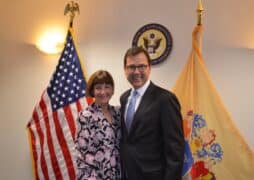

Jennifer Flores, technical writer for mission at Komen, discusses how she and her advocacy team used their voices and personal stories to inspire policy change at this year’s Advocacy Summit in Washington, D.C.
Every day, women and men across the U.S. are diagnosed with breast cancer. In fact, about 316,950 women in the U.S. will be diagnosed with new cases of invasive breast cancer in 2025. Behind each of these numbers is a unique and personal story, and if you’re lucky like me, you get the chance to hear some of these stories firsthand and meet some of the most amazing people in person.
This year, as a Komen employee and breast cancer advocate, I had the privilege of attending my first Susan G. Komen Advocacy Summit in Washington, D.C. Like most everyone in attendance, I came to D.C. to share my own personal experiences with lawmakers, with the hope that it would make a difference. Just two months prior to the summit, I faced my own hurdle of a cancer diagnosis, so I felt an even deeper sense of solidarity with the 200 others I lobbied with on Capitol Hill this year.
While I learned many new things from this year’s summit, nothing stood out to me as much as how our personal stories can inspire change. As I learned from listening to my new friends and fellow advocates, when we raise our voices together, we have the power to influence lawmakers and create real, lasting policy change. This lesson would not have been possible without my amazing crew of Texas advocates. Here, in no particular order, are some of their stories.
Cost Should Not Be a Barrier to Care
Komen Advocacy Ambassador, Shelarri Anderson is one of many women in the U.S. who is at a high risk for breast cancer and facing unexpected barriers to access affordable diagnostic and supplemental screening. At the summit, Shelarri spoke at a Congressional luncheon as a member of Komen’s newly launched Alliance for Breast Cancer Policy. She explained that an automated voicemail informed her of suspicious findings on her mammogram. However, she was told she had to pay her diagnostic screening bill in full before she could proceed.
Shelarri’s story illustrates a harsh reality: The cost of care remains one of the greatest barriers to accessing critical diagnostic and supplemental screening for breast cancer. On Capitol Hill, Shelarri shared her story in several meetings with policymakers, asking for their support of the Access to Breast Cancer Diagnosis (ABCD) Act. The ABCD Act aims to help people like Shelarri by requiring private insurers to cover the full cost of diagnostic and supplemental breast imaging.
“We must continue to push for access to early diagnosis and timely treatment,” Shelarri says. “This isn’t just about policy, it’s about giving people a fighting chance.”

Research Inspires Hope Where It’s Needed Most
Komen Advocacy Ambassador Lashelle Scott was diagnosed with stage 3 HER2-positive invasive ductal carcinoma in 2021. She also learned through genetic testing she has an inherited BRCA2 gene mutation. Since then, she has undergone several rounds of chemotherapy and immunotherapy, as well as a bilateral mastectomy. In addition to the financial burdens that come with her treatment, Lashelle is also challenged by her lack of eligibility for clinical trials due to her type of breast cancer.
At this year’s summit, she met with multiple legislators to ask that $150 million in annual federal funding be restored to the Breast Cancer Research Program (BCRP) in FY26. Through the Department of Defense, the BCRP supports innovative, groundbreaking breast cancer research programs that help women like Lashelle who have limited options for treatment. We learned through a summit briefing that Congress recently cut funding for the BCRP by $20 million.
“Investing in research and clinical trials provides patients with more treatment options,” Lashelle says. “Without research, we would not be closer to a cure, and it helps patients like me have hope.”
Komen Advocacy Ambassador Aleta Hall has also seen first hand how research can change the landscape of breast cancer treatment. “Research is everything,” she says. “I know that my mom’s second battle was different in a good way due to the strides made in research over that 15-year span.” Through her stories at this year’s summit, Aleta advocated for her mom and two sisters, who have all faced a breast cancer diagnosis.
“So many people have been touched by breast cancer and those voices need to be heard, including yours.“
Aleta Hall, Komen Advocacy Ambassador
“There are five adult females in my immediate family and three of them have been diagnosed with breast cancer,” she says. “Supporting them is very important, but research could also save the lives of my two young daughters in the future.”
Lashelle and Aleta provided lawmakers with a vivid illustration of why research funding is so critical to the breast cancer community.

Your Voice Truly Matters
Komen Advocacy Ambassador John Scoblick has been a passionate advocate since 2019, when his beloved daughter Melissa died from breast cancer. To honor her legacy, John transformed his grief into action by sharing Melissa’s story to push for meaningful policy change. John has also spoken to several media outlets on behalf of Melissa, and has told her story through the Komen blog and Real Pink podcast.
Through his tireless lobbying and meetings with members of Congress, John is working to ensure more people have access to lifesaving screening. His story of Melissa’s strength in the face of an unexpected recurrence resonates with lawmakers and underscores the urgent need for better access to screening.
The SCREENS for Cancer Act (H.R. 2381) would ensure that more people, including those in low-income or under-resourced populations, have access to the screenings for breast and cervical cancer. Without regular screenings, too many people are forced to face late-stage cancer diagnoses. For John, speaking up for the entire breast cancer community is a deeply personal mission.
“I have a mission as a Komen advocate to provide a compelling voice for thousands of people impacted by breast cancer whose voices may never be heard and whose faces may never be seen,” he says.

You Can Be the Change
Every advancement in breast cancer policy is fueled, in part, by those who refuse to stay silent. None of these wins happened in a vacuum; they all happened because patients and survivors spoke up and shared their stories. From ensuring everyone has access to screening and early detection to funding groundbreaking research, your voice has the power to shape the future of breast cancer care and save lives.
“Everyone’s voice is important, and everyone’s story is different,” Aleta says. “So many people have been touched by breast cancer, and those voices need to be heard, including yours.”
I know that every member of my group plans to attend Komen’s Advocacy Summit next year, so they can continue to share their stories. How will you share yours?

Your experience matters. Your voice matters. And when you speak up, you may not only change a policy. You may also save a life.
How you can get involved:
- Sign up to become an Advocacy Insider.
- Share your story.
- Sign the petition for the Breast Cancer Bill of Rights.