
Susan G. Komen-led research was spotlighted at the 2025 San Antonio Breast Cancer Symposium (SABCS) held this week. This is the world’s largest breast cancer conference, and Komen was honored to contribute to the discussion by presenting pivotal work aimed at addressing needs within the breast cancer community.
ASSESS: A Personalized Early Breast Cancer Treatment Decision Support Tool and Resource Website
We’ve learned an incredible amount about breast cancer, giving patients and doctors more information than ever to make informed treatment decisions. However, the wealth of information available can make a personalized breast cancer treatment plan difficult to nail down.
“Even with access to trusted evidence-based information, patients and doctors may struggle to account for the many factors in an individual’s unique diagnosis that influence treatment and outcomes, making it hard to balance the potential benefits of therapy with the risks of side effects on a personalized basis,” said Komen Scientific Programs Manager, Bethany Kerr, Ph.D.
To help address this challenge, Komen, in partnership with The University of Texas MD Anderson Cancer Center and Yale Cancer Center, created ASSESS, a free online tool that provides a personalized five-year survival estimate based on an individual’s personal and pathologic information. The web-based shared-decision support tool utilizes, but does not store, several pieces of information, including age at diagnosis, menopausal status, subtype, tumor size/grade, lymph node status and whether or not a woman has a BRCA inherited gene mutation. Komen provided funding to teams at MD Anderson and Yale to develop an algorithm that uses data from the U.S. national cancer database, called SEER, and randomized clinical trials to help women and their doctors make informed decisions about treatment choices for early breast cancer by showing how different options may impact survival.
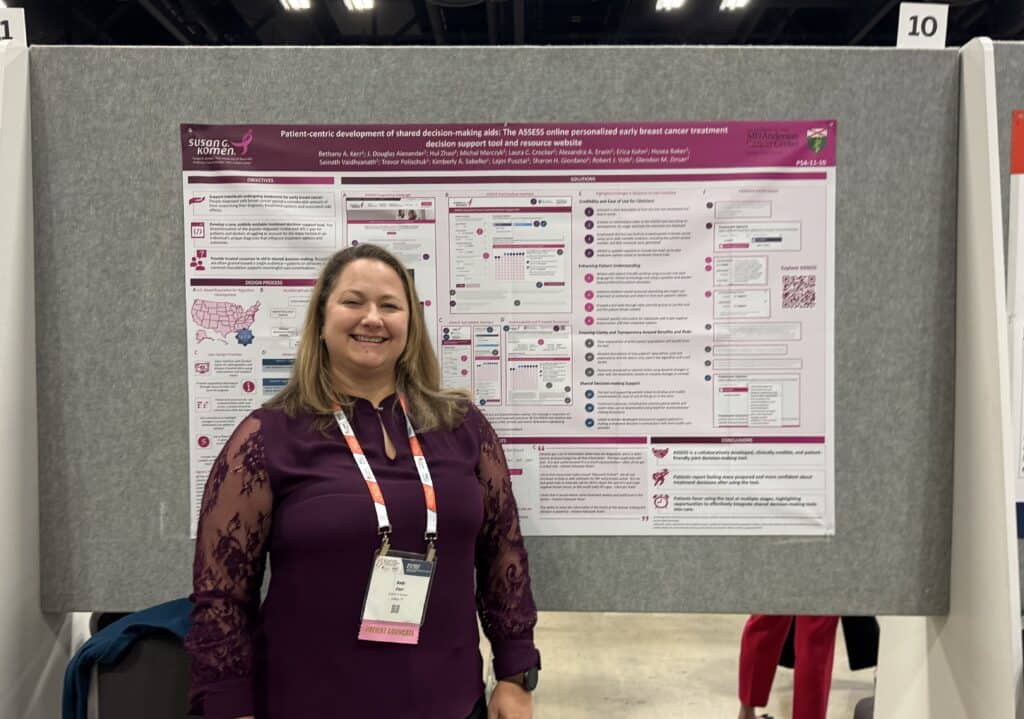
Kerr, who presented the work at SABCS (Poster PS4-11-10), said “the ASSESS tool was created using a patient-centered approach to support shared treatment decision-making between individuals recently diagnosed with early-stage breast cancer and their health care team.”
Kerr noted that ASSESS, along with additional resources offered within the online tool, “empowers patients with evidence-based, understandable information, enabling them to be actively involved in their treatment decisions.”
A breast cancer diagnosis can be overwhelming, but by providing this free user-friendly tool, individuals can work with their doctors to be informed and feel more confident in their treatment plan.
Expanding Inflammatory Breast Cancer (IBC) Research and Care
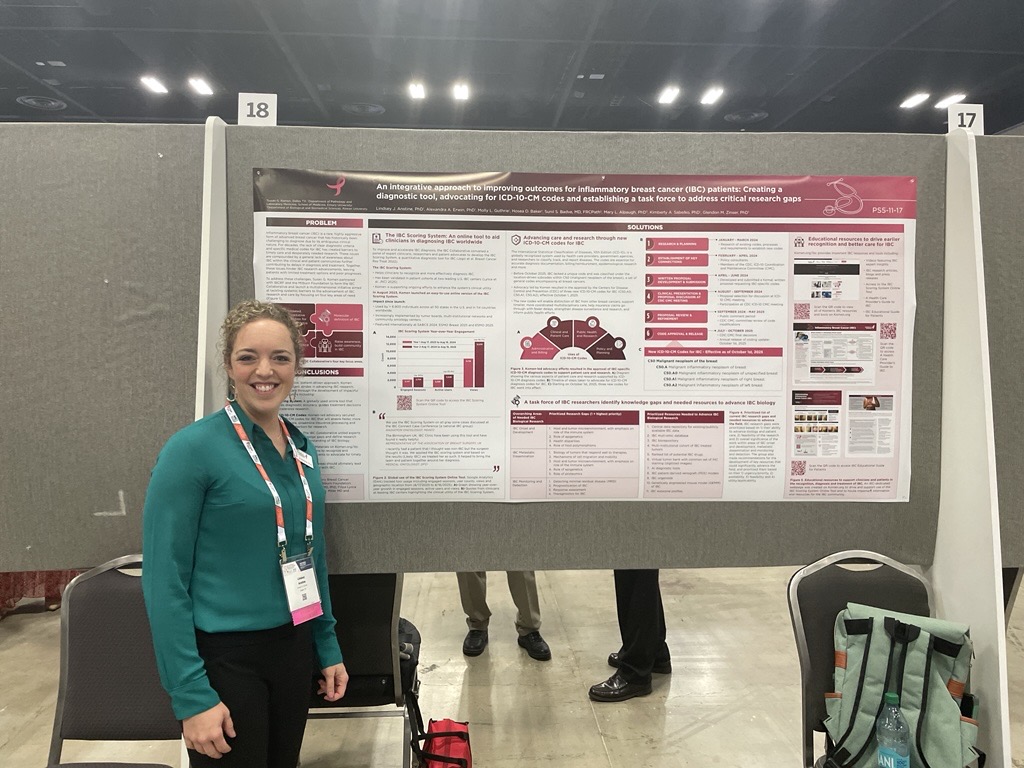
Inflammatory Breast Cancer (IBC) is rare, highly aggressive and hard to treat. “IBC can be difficult to recognize because patients often do not have a lump; and common IBC signs and symptoms like redness and swelling can look like a breast infection (mastitis). Additionally, IBC has historically lacked clear diagnostic criteria and specific diagnosis codes, making it challenging for providers to distinguish the disease from other conditions,” said Komen Scientific Programs Manager, Lindsey Anstine, Ph.D. “These issues have led to delays in diagnosis and treatment and have hindered research advancements, leaving IBC patients with limited treatment options and poor prognoses.”
To address this problem, Komen teamed up with the Inflammatory Breast Cancer Research Foundation (IBCRF) and the Milburn Foundation. This partnership has resulted in the development of key resources and activities that are helping to expand IBC research and care, including:
- The IBC Scoring System — This online tool can help clinicians to recognize and more effectively diagnose IBC. Since its debut in August of 2023, the tool has been used more than 6,000 times in 114 countries worldwide and is being increasingly utilized by tumor boards, multi-institutional networks and community oncology centers to help diagnose IBC.
- Official IBC Diagnosis Codes — Komen led advocacy efforts to establish diagnosis codes for IBC. Effective as of October 2025, these codes support better access to treatment, help expedite insurance claims and improve the identification and collection of IBC patient data to advance research.
- IBC Educational Resources — Komen’s educational resources can help clinicians identify, diagnose and treat IBC; and provide information to patients about how to recognize IBC signs and symptoms, when to seek medical attention and how to advocate for themselves.
- Research Task Force — To advance IBC research, expert IBC researchers and clinicians were convened to identify knowledge gaps in IBC biology that, if addressed, would enhance our understanding of how IBC starts, spreads and can be monitored. These insights will be used to guide future funding opportunities and collaborative efforts that could ultimately lead to improved outcomes for patients.
Anstine, who presented this work at SABCS (Poster PS5-11-17), said “By tackling systemic barriers to the advancement of IBC research and care, we’ve made significant advances with potential to improve outcomes for people with IBC.”
Click here to learn more about Komen’s ongoing effort to accelerate IBC research.
Development of the ShareForCures® Research Hub – Accessing Participant Data
We know that breast cancer research saves lives. But for maximum impact, researchers need access to real data from people that have been diagnosed with breast cancer.
“Multi-faceted patient data, including clinical records, genomic information and patient experiences, are currently fragmented and locked away in siloed health care institutions,” said Komen Data Science Program Manager, Kelsi West, Ph.D., MPH. “Additionally, existing research datasets often fail to reflect the true diversity of patients’ experiences and demographics, creating significant gaps in knowledge that impact our ability to deliver on the promise of precision oncology.”
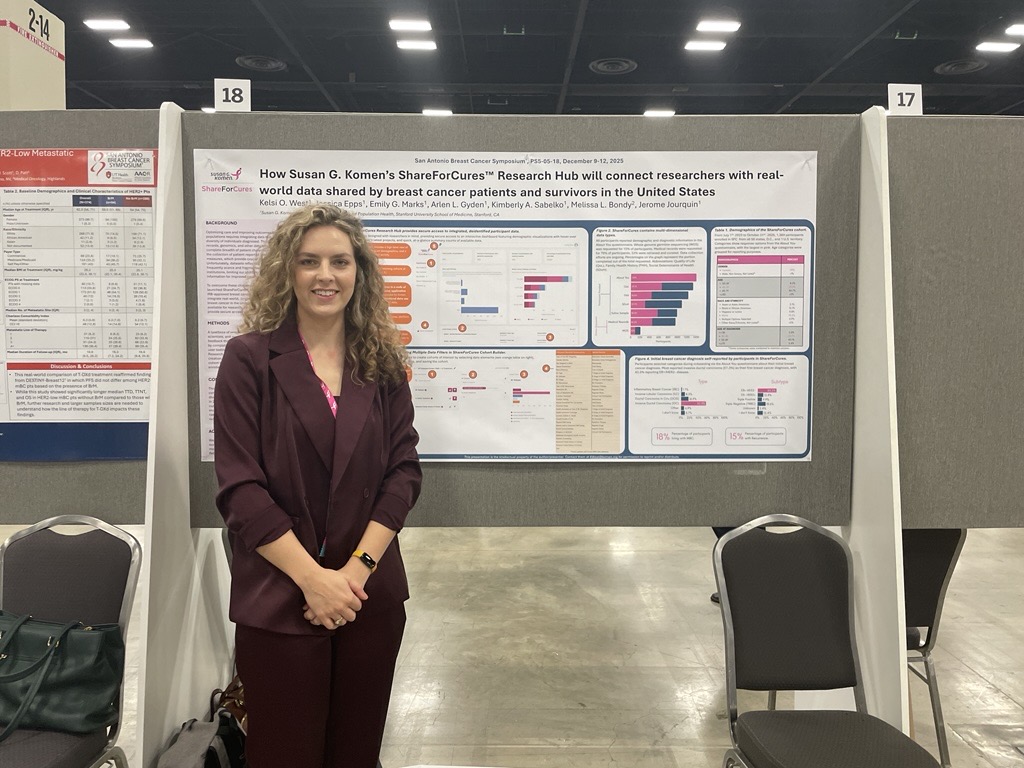
To help address this dilemma, Komen launched ShareForCures® in July 2023 as an ongoing breast cancer research registry, providing an opportunity for participants to consent to share their medical records, biosamples and complete surveys. As of November 2025, more than 1,400 participants from across the U.S., including Puerto Rico, have enrolled.
Data provided by ShareForCures participants are integrated and de-identified to create research-ready datasets that will be made securely available to researchers through the ShareForCures Research Hub, which is expected to launch in 2026.
West, who presented this work at SABCS (Poster PS5-05-18), shared that the Research Hub will benefit both researchers and participants. “For participants, [it] offers a direct way to ensure their unique experience can be leveraged for research. For researchers, [it] provides secure access to integrated, real-world data that has traditionally been difficult to obtain. Importantly, the registry includes populations often excluded from or understudied in traditional research.”
West added, “by making rich, diverse datasets easily accessible, ShareForCures has the potential to improve outcomes for all breast cancer patients.”
Analysis of ShareForCures Data – Participant-Reported Data vs. Medical Records
While ShareForCures data is not yet widely available to researchers, Komen has partnered with Stanford University to initiate early research studies using ShareForCures data.
James Dickerson, M.D., M.S., of Stanford University, who presented this analysis at SABCS (Poster PS5-05-10) said, “We used the data in ShareForCures to test whether readily available, multi-dimensional participant-reported clinical details can serve as a reliable alternative to medical records for life-saving breast cancer research.”
Since patient-reported information is easier to access, researchers wanted to see if it could be reliably used in the place of the more difficult-to-access medical records. Dickerson also noted that “medical records lack details about what patients experience, their preferences, their outcomes, etc. Those participant-reported details are key to advancing personalized care.”
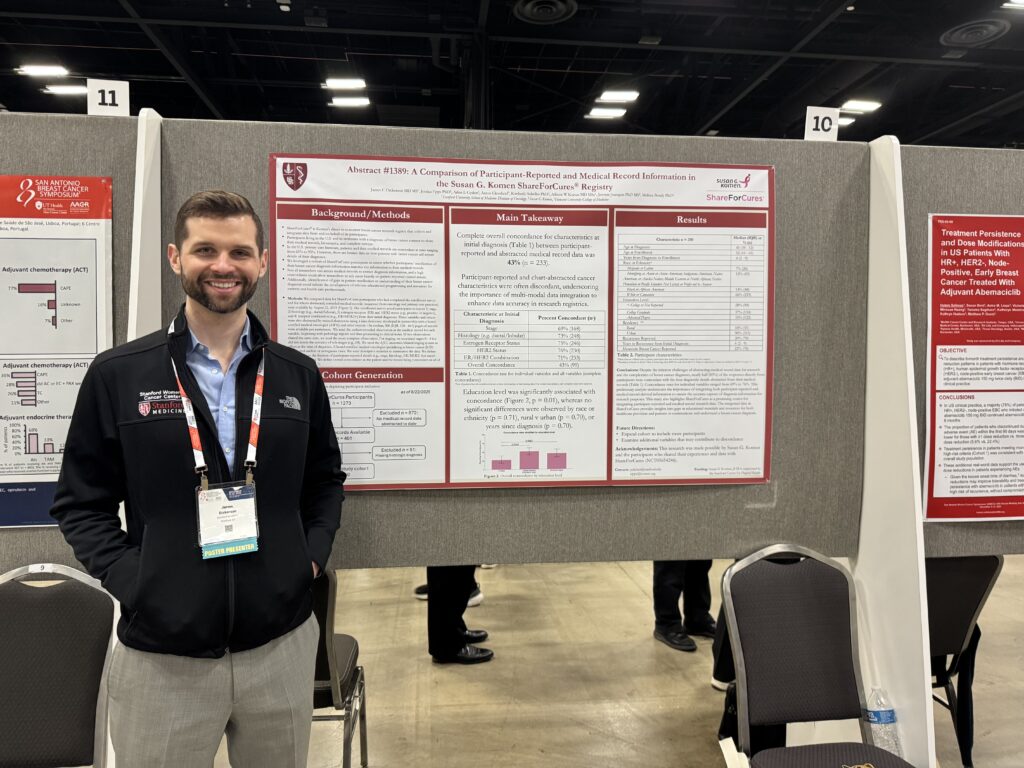
Early analysis from this study shows that roughly half of the responses from participants aligned with the information pulled from medical records. Ultimately, this preliminary work further supports the need for ShareForCures and use of both patient-reported and medical records in research.
Visit Komen.org to learn more.