
With National Breast Cancer Awareness Month coming soon in October, you’ll likely see a lot more conversation and news coverage about getting screened or prioritizing your health. To better illustrate why mammograms are so important, below, you’ll find the top five reasons to get a mammogram.
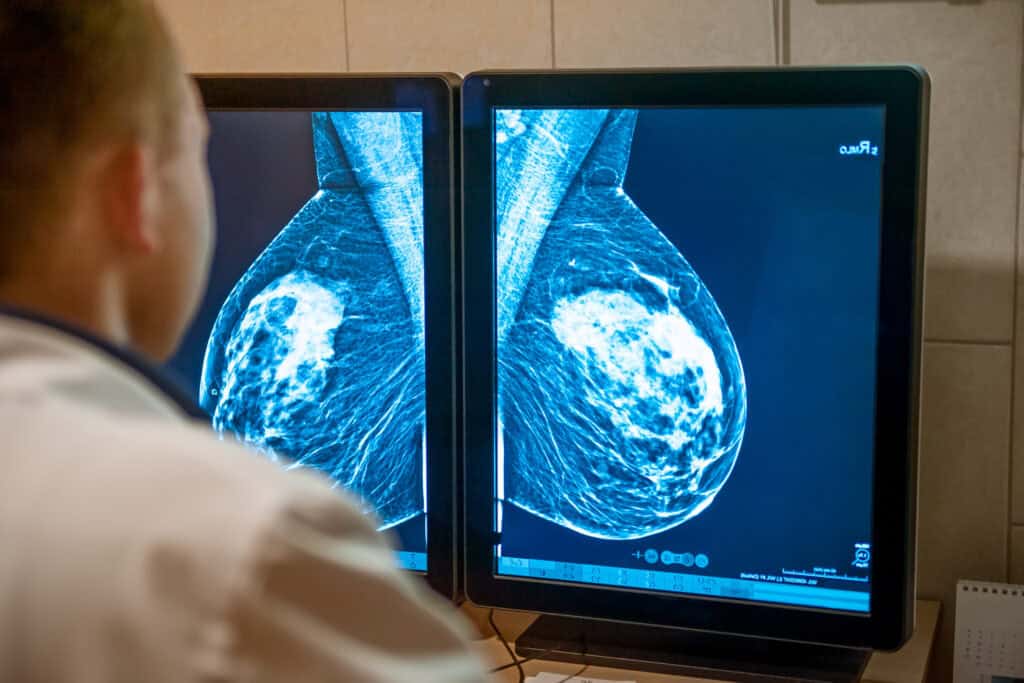
While yearly mammograms are considered a normal routine for women over the age of 40, other women may still be skeptical or confused about mammograms. They may wonder why they’re so important or if they are really necessary.
5. Mammograms are quick and easy
Most of the time, mammograms take about 15 minutes from start to finish. It takes more time to schedule and answer questions about the appointment than the actual test itself! During the exam, each breast is pressed between two plates and X-ray images are taken. There will be some pressure, and it might feel uncomfortable, but this only lasts a few seconds. Let your technologist know if you have any concerns or if you feel any discomfort during the exam.
4. Mammograms are recommended every year starting at age 40, or earlier if you and your doctor decide it’s necessary
Because many changes can occur in a woman’s breast from year to year, annual mammograms are important. Just because you’ve had one normal mammogram doesn’t mean you’re covered for a certain period of time, like a colonoscopy or pap smear. In fact, having a mammogram every year increases the chances of finding breast cancer early.
3. Mammograms are important, even for those with no family history
There’s a lot of misinformation about breast cancer and family history. Is family history important when determining someone’s breast cancer risk? Absolutely! It’s one of several factors that doctors use to determine who would be considered at higher risk. Does this mean those without a family history don’t need to be screened? No. In fact, about 10% to 15% of women diagnosed with breast cancer have a first-degree female relative —meaning a mother, sister or daughter — who’s had it. This means 85% to 90% of breast cancers are caused by something else. Family history is just one piece of a much larger puzzle. Talking with your doctor about your risk of breast cancer is one of the most important things you can do. Together, you can develop a screening plan that’s right for you.
2. Mammograms can find breast cancer early (when there are no warning signs)
Most early-stage breast cancers in the U.S. are found with screening mammography, before any warning signs or symptoms appear. Is mammography perfect? No, nothing is perfect, but mammography is the most effective screening tool used today to find breast cancer early, before it can be felt by you or a doctor.
And the most important reason mammograms are important….
1. Mammograms reduce your chances of dying from breast cancer
You’re probably asking, “how is this possible?” As mentioned above, mammograms can find breast cancer in its earliest stages, which means that people have a greater chance of long-term survival.
Studies show women ages 50 to 59 who got mammograms have a 14% lower risk of dying from breast cancer compared to women who didn’t get mammograms. The benefit is even greater for women ages 60 to 69 with a 33% lower risk of dying from the disease compared to women who didn’t get mammograms.
Oftentimes, we tend to prioritize “adulting” — whether it be work, family, parents, children or maybe all of those at once — over our own health. Make your health a priority and take 15 to 20 minutes a year to get a mammogram so you can be there for all the important things in your life.
Susan G. Komen® believes all women should have access to regular screening mammograms when they and their doctor decide it’s appropriate based on their risk of breast cancer.
Here are a few actions you can take:
- Talk with both sides of your family about your family’s health history. The family health history tool on komen.org is a great place to start gathering this information.
- Talk to your doctor about your risk of breast cancer. If your doctor doesn’t bring up breast cancer risk or screening, start the conversation and ask questions about which screening tests are right for you. Advocate for yourself!
Get screened:
- For those at average risk, have a mammogram every year starting at age 40 if you’re at average risk.*
- Have a clinical breast exam at least every three years starting at age 25, and every year starting at age 40.
- For those at higher risk of breast cancer, you may need to be screened earlier, and more often. Talk with your doctor to get a personalized screening plan based on your unique risk factors.
* Per NCCN guidelines
Learn more about breast cancer screening, including how to prepare for a mammogram and possible findings.
Finally, if you have questions, need help finding a mammogram or just have other breast health or breast cancer-related questions, Komen’s Patient Care Center is your trusted, go-to source for timely, accurate breast health and breast cancer information, services and resources. Our navigators offer free, personalized support to patients, caregivers and family members. Call 1-877 GO KOMEN (465-6636) or email helpline@komen.org. The Helpline is available Monday through Thursday, 9 a.m. – 7 p.m. (ET) and Friday, 9 a.m. – 6 p.m. (ET). Se habla español.