
You’ve obviously heard of breasts, but have you heard of dense breasts? It’s possible you haven’t.
What do we mean when we say, “dense breasts?”
Breasts are made up of fat and tissue. The tissue part includes lobules (small, round sacs that produce milk) and milk ducts (canals that carry the milk from the lobules to the nipple). The breast also has connective tissue that holds its different parts together.
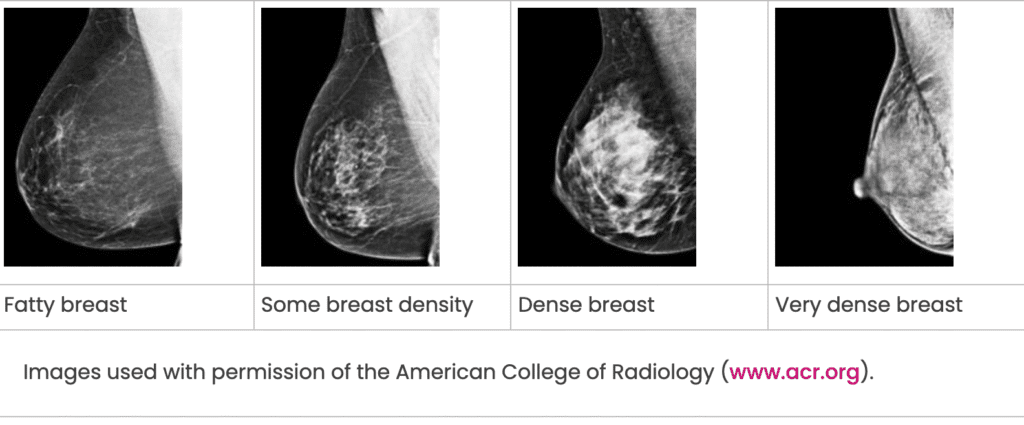
If a mammogram shows you have more tissue in your breast than fat, you have what’s called dense breasts. Having dense breasts does not describe how your breasts feel; instead, it describes mammogram findings.
Why does breast density matter, especially if I am young?
Dense breasts are common, and even more common in young women. About 50% to 60% of women within the 40 to 44 age group have dense breasts, compared to 20% to 30% of women ages 70 to 74.
Unfortunately, dense breast tissue can make it way harder to spot breast cancer on a mammogram. It’s like trying to find a polar bear in a snowstorm. With dense breast tissue, it’s tough to distinguish between breast cancer and the surrounding tissue.
Additionally, women with very dense breasts are 4 to 5 times more likely to get breast cancer than women with less-dense (fatty) breasts.
So, how do I find out if I have dense breasts?
Komen helped pass federal legislation that requires health care facilities to notify patients via a letter whether they have dense breasts after receiving a screening mammogram. This requirement standardizes the notification language people receive, ensuring all individuals across the country have consistent information about the makeup of their breast tissue.
The reports include an overall finding stating whether your breasts are dense or if they are not dense, as well as additional information and detail about the level of density:
- Breasts are almost entirely fatty (not dense).
- Breasts have scattered areas of fibroglandular density (not dense).
- Breasts are heterogeneously dense, which may obscure small masses (dense).
- Breasts are extremely dense, which lowers sensitivity of mammography (dense).
If you’re told you have dense breasts following a mammogram, don’t panic. It’s important for you and your doctor to know this information so that you can be more vigilant and potentially detect breast cancer early.
While there are no special recommendations or screening guidelines for women with dense breasts, your doctor may suggest other types of breast imaging in addition to regular mammograms. Just ask your doctor if you need additional tests, such as a breast ultrasound or MRI. Knowing your risk will help inform the conversation with your doctor, too. If you need to talk to someone or have follow-up questions, reach out to the Komen Patient Care Center.
Dense or not, knowing your body (and your breasts) is self-care. You’re never too young for self-care.
Learn more about dense breasts, what additional tests your doctor may recommend for you and what Komen is doing to make sure these tests are covered by insurance at Komen.org.
Are you a college student looking to spread awareness about breast health? Empowered is a digital go-to guide for college students designed to share need-to-know information about breast health, including breast cancer risk factors like breast density. Through this guide, students can navigate their way through Komen resources that will help them stay on top of their breast health. Click here to download this free resource.