
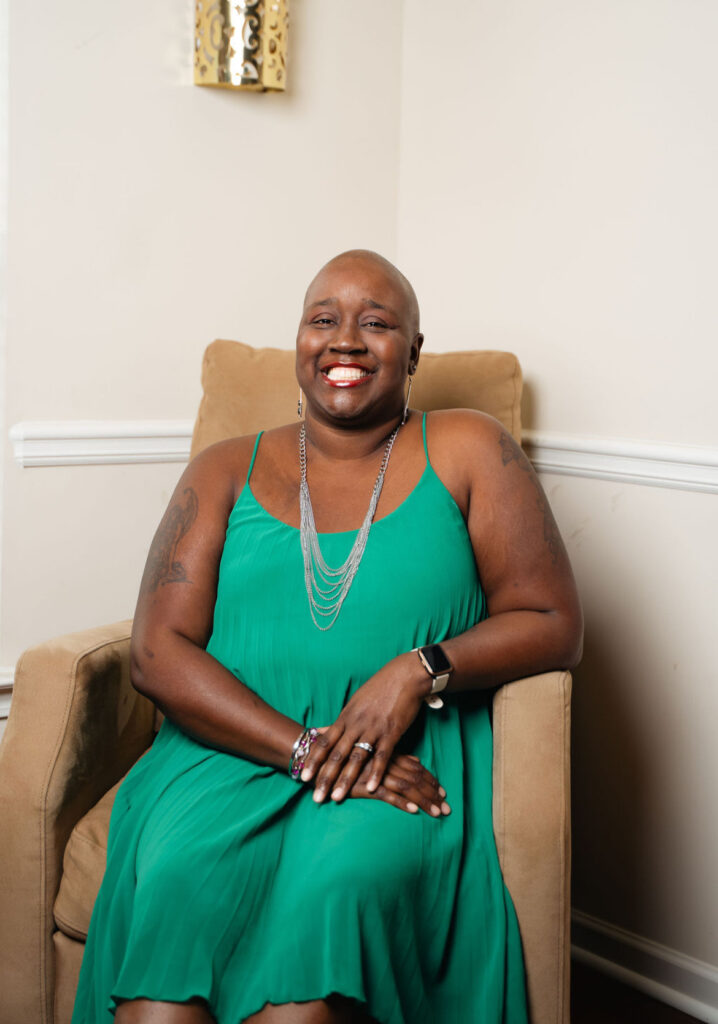
Three years after finishing treatment for stage 1 breast cancer, Lea learned she had metastatic breast cancer(MBC), for which there is no cure today. She’s been married to her wife, Shaun, for 11 years, and has a son in college and a daughter in high school. “My family is my reason why, my motivation and my anchor,” Lea said.
The First Diagnosis
In 2017, Lea felt a lump in her breast. At first, she thought it was an ingrown hair, but noticed the lump wasn’t going away. “It was hard to the touch and uncomfortable, even though it was relatively small,” she said. “I was young, just 37, but I remember thinking that I needed to have it looked at.”
Lea’s primary care physician also thought it could be an ingrown hair and was resistant when Lea asked for a mammogram. “I explained an aunt had breast cancer and I really wanted to have it looked at,” Lea said. “I wouldn’t take no for an answer. She finally agreed, but told me insurance wasn’t going to approve it, and I said I was willing to take that chance.”
Lea’s first mammogram came back abnormal. She was told she had calcifications and to come back in six months for a follow up. “After the second mammogram, they ordered a biopsy, which came back showing I had stage 1 breast cancer,” she said.
Her treatment included a lumpectomy, followed by a double mastectomy. “By 2018, I was done with treatment. I believed that everything was fine,” Lea said. “I truly thought I’d done what I needed to do.”
A Troubling Pain
In 2021, Lea started experiencing some pain in her right hip. “I was working and doing a lot of up and down movement. When my hip started giving me problems, I went to the urgent care,” Lea said. “They diagnosed it as sciatica and sent me on my way. Two months later, I could hardly walk. I was dragging my right leg.”
Lea was told there were lesions in both of her hip sockets and on her femurs “I was sent to my primary care doctor, who ordered an MRI so we could see if these were benign or malignant.”
Devastating News
Lea learned she had MBC on her birthday. “My first thought was whether I was going to die,” she said. “It was a big shock. And then, after I got over the initial fear of dying, I thought, okay, what’s the game plan and started asking questions. I wanted to know how to preserve my life. It was important for me to be here for my children and spouse.”
Switching Doctors
Initially, Lea thought she had a doctor she could trust, but as she asked questions and pressed for a plan, she felt there was a lack of transparency.
“I didn’t feel like my voice mattered. She wanted me to stop working, but I knew that was something I didn’t want to do. I have children andwant to provide for them,” Lea explained. “I knew I couldn’t just sit at home.” Lea also wanted to incorporate some holistic care into her treatment plan, which her doctor didn’t seem interested in talking about.
The final straw for Lea was one afternoon when she collapsed in pain and was unable to get up. Her wife rushed her to the hospital, where Lea learned she had tumors on her spine, information her doctor hadn’t shared with her. “When I asked her why she hadn’t told me, she said it was in the report,” Lea said. “I knew I needed someone who would explain things to me.”
Treated as a Whole Person
Lea found a new oncologist with whom she feels comfortable. “He treats me as a whole person,” she said. “He listens, explains and includes me in every decision. That partnership restored my confidence and gave me space to fight with clarity and dignity.”
Living With Metastatic Breast Cancer
Lea is currently in active treatment and recently learned the cancer has spread to her liver. This caused a change in her treatment plan, and she’s now taking Taxol (a chemotherapy drug). “It’s difficult, but I’m hopeful,” she said.
For a while, Lea was upset that when she underwent treatment for cancer the first time, no one recommended she start tamoxifen (a hormone therapy), which may have led to a different outcome. “I joined support groupsand have done counseling, and I speak out now about the importance of advocacy,” she said. “For a long time, I didn’t allow myself to grieve. I stayed busy and pushed forward. Eventually, I took a year away from work to sit with my emotions, mourn what I had lost and rediscover myself. That pause became one of the most healing decisions I’ve ever made.”
Moving Forward with Love
Lea’s children provide her with love and support, as does Shaun. “My wife has been my constant. She’s my caregiver, my best friend, my safe place,” said Lea. “Cancer has tested us, but it has also deepened our love. Today, I use my voice to advocate for women, especially Black women, to trust their bodies and speak up in medical spaces. I believe my story is not just for me. I’m meant to help someone else feel seen, heard and less alone. As long as I have breath, I will continue to live with purpose, faith and hope.”
Listen to Lea share her story.
To learn more about living with MBC, please visit the MBC section of komen.org. You can also learn more about getting high-quality care on komen.org.
Statements and opinions expressed are those of the individual and do not express the views or opinions of Susan G. Komen. This information is being provided for educational purposes only and is not to be construed as medical advice. Persons with breast cancer should consult their health care provider with specific questions or concerns about their treatment.