
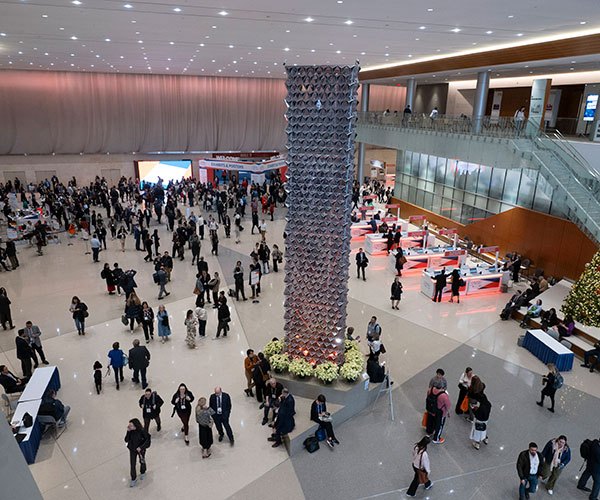
We’re here to break down what we’re watching at the 2025 San Antonio Breast Cancer Symposium (SABCS), including exciting new research, clinical trials and science driving meaningful change in breast cancer care. SABCS is the largest breast cancer symposium in the world, and this year is its 48th year bringing clinicians, patients, advocates and researchers together to share the latest discoveries.
We spoke with three breast cancer experts to learn what they’re watching at this year’s conference, how it may impact the care they provide to patients and why it matters for people facing breast cancer today.
Moving the needle with ctDNA & new treatment options
Komen Scientific Advisory Board member and physician-scientist Ben Ho Park, M.D., Ph.D., is looking forward to findings that could shape how breast cancer is detected and tracked. That’s because a key topic of the meeting, and breast cancer research as a whole, is circulating tumor DNA or ctDNA – sometimes called “liquid biopsy.” This blood test looks for tiny pieces of cancer DNA shed in the bloodstream, which could help determine if a treatment is working, if cancer is returning or if it’s completely gone.
“We’ve known about this for decades,” said Park. “But we never had good enough technologies to really isolate it and analyze it.” That’s now changing. Researchers are finding that a blood test can tell a lot about whether a cancer will return “with the highest accuracy we’ve ever had.”
Park explained that ctDNA testing is at times already being used with some people living with metastatic breast cancer, helping oncologists identify the cancer’s genetic profile and select targeted therapies. He’s especially excited for clinical trial data being presented about using ctDNA in the early-stage setting to detect minimal residual disease – cancer that remains after treatment but is too small to be detected on scans.
Park also looks forward to the new results being presented from the HER2CLIMB-05 clinical trial exploring the use of the targeted therapy, tucatinib, combined with standard treatment for people with HER2-positive (HER2+) breast cancer. This approach could be especially helpful in preventing or delaying cancer spread to the brain. “This could actually set a new standard of care,” Park said.
Komen will also be following the results of the lidERA clinical trial, which is testing whether a new oral selective estrogen receptor degrader (SERD) called giredestrant can more effectively prevent recurrence than standard hormone therapies in some patients with early-stage hormone receptor-positive/HER2-negative breast cancer. If FDA-approved, this would be the first new hormone therapy for early-stage breast cancer in more than 20 years.
Beyond the science, Park is energized by how SABCS fosters collaboration and education. “We don’t work in silos in breast cancer. We really work together, and we know that’s necessary to move the needle.”
Evaluating when less is more
Reshma Jagsi, M.D., D. Phil., is a Komen Scholar and radiation oncologist closely watching studies that aim to reduce the physical burden of treatment. One key topic at the meeting is the de-escalation of axillary surgery, which refers to underarm lymph node surgeries that have been a part of breast cancer care for a long time.
“For many years, the standard of care was something called a complete level 1 and 2 axillary lymph node dissection,” Jagsi explained. “This was an extremely invasive surgical procedure that had high rates of really meaningful side effects like lymphedema, swelling of the arm that compromised function [and] the ability to perform work-related tasks.” That kind of swelling, she emphasized, is “not only very symptomatically unpleasant, but also limiting in the things that mean the most to us.”
Today, there’s a shift toward doing less when it’s safe to do so. “Over time, we’ve even found that there are some patients who do have some spread to that initial sentinel lymph node who might still be candidates for other treatments that don’t involve more surgery or that might be more tolerable to the patient,” she said. Several studies being presented at SABCS will explore the safety and impact of these less aggressive approaches.
Jagsi also highlighted the P-RAD trial, which is exploring whether radiation before surgery – in combination with immunotherapy and chemotherapy – can better activate the immune system to fight cancer.
Jagsi mentioned how so much is happening beyond these topics too: “There’s everything from educational sessions on the impact of lifestyle and breast cancer risk and recurrence, to sessions on lobular breast cancer, breast cancer in young women, toxicity, disparities, AI, genomics. You name it,” she said. “Caring for patients with breast cancer is a team sport, and I am excited to learn from colleagues in all different areas of work.”
Using genetics to support personalized care
SABCS also provides space for exploring the future of screening and risk assessment. Komen Scholar Susan Domchek, M.D., is looking forward to updates from the WISDOM trial. This study evaluates “how we can use information about genetics and things called polygenic risk scores to group people based on risk so they benefit from a more personalized screening plan,” Domchek explained. Polygenic risk scores look at the many small changes across a person’s DNA to estimate their overall risk of breast cancer even for those without BRCA1 or BRCA2 inherited gene mutations.
This research could help providers better understand who is at risk and when to intervene: “If someone’s at risk for developing cancer, you can provide enhanced screening and risk-reduction options,” she said. “It’s going to be really important to see how we’re going to use this information … and, most importantly, how it benefits patients.”
Whether through early detection, cutting-edge treatments or post-treatment support, Domchek emphasized how SABCS brings people together to translate science into care, stating that it “really allows us to collaborate together and advance the care for our patients.”
SABCS connects science to survivorship
Our experts agree that discoveries shared at SABCS often lead to real-world changes in care. For all patients, staying informed about breast cancer research can empower you to ask questions and understand your options. “Many of the findings at SABCS can have Monday morning implications,” Jagsi said. “They change the conversations we’re having with patients almost immediately.”
Follow Komen’s social media channels for live conference updates this week!
Stay tuned for our 2025 SABCS Highlights Blog that will be published following the meeting.


