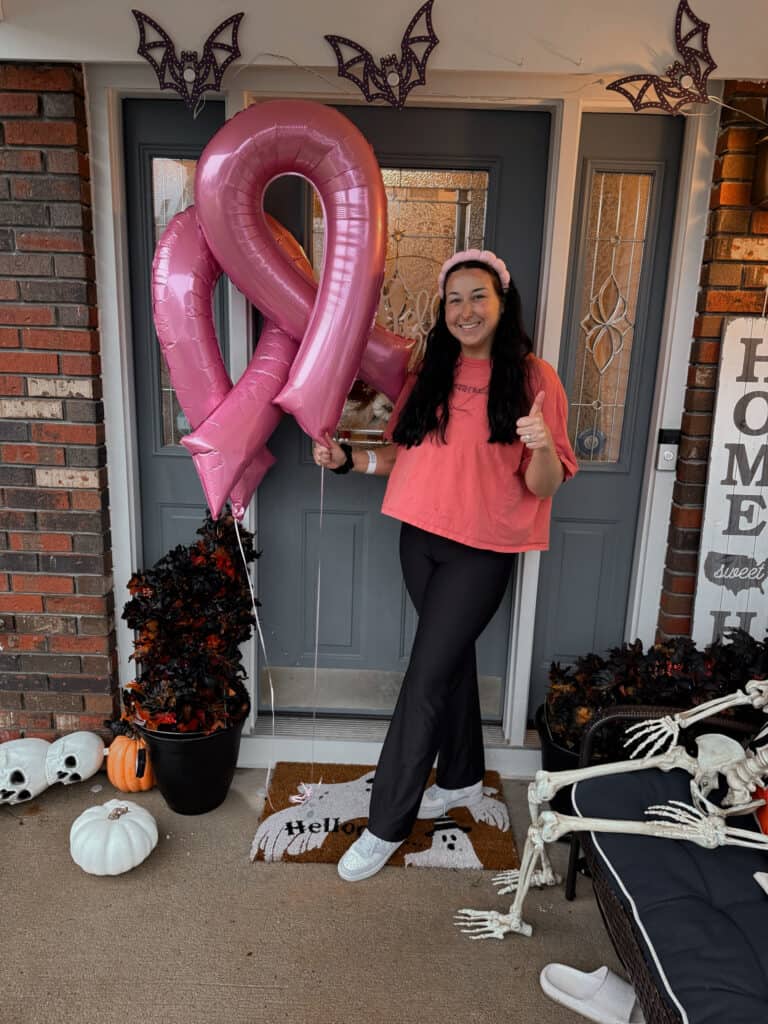
Marisa learned she had breast cancer in 2025, when she was 31. This is her story in her own words.
Something Looks Different
I never thought breast cancer was something I needed to worry about, especially at 31. I was married with two young boys and had no family history of breast cancer. I was years away from having my first routine mammogram. I never felt a lump. I only knew something was wrong because I knew what was normal for my body.
After my second son was born, I noticed that one of my nipples looked different. It was cracked and chapped. There was a clear liquid that would come out if I squeezed it. I kept thinking it might be related to having a baby. However, after a few weeks, I knew it just didn’t look normal for me.
I made an appointment with my doctor. She prescribed a cream and told me to come back if it didn’t improve. When it didn’t, the doctor sent me for a diagnostic mammogram.
Paget’s Disease & A Breast Cancer Diagnosis
At the end of May 2025, I learned I had stage 2 invasive ductal carcinoma, HER2-positive and hormone receptor-negative. I also had Paget’s disease of the nipple. I remember getting the news through my online chart while my husband was outside watering the plants. I opened the notification and started crying.
My first thought was my kids. I was terrified that I was going to die and that I wouldn’t get to see them grow up. I had gone into that mammogram thinking my symptoms were probably pregnancy-related, so the diagnosis felt completely impossible. I didn’t know what my life was going to look like anymore.
A Treatment Plan
Once I finally met with my oncologist and we knew exactly what we were dealing with, having a treatment plan helped me start moving forward. My oncologist told me that I would need chemotherapy. I really hoped I could avoid chemo, but he also reassured me that the cancer was going to respond to treatment. My treatment would also include surgery and radiation therapy.
Experience with Chemotherapy
I started chemotherapy in June and finished in October. It was difficult in ways I expected and in ways I didn’t. I had an allergic reaction during my first infusion that made my chest feel like it was burning. It happened again the next time, so the team gave me a lot of Benadryl before subsequent treatments to prevent another reaction.
The days after chemo were usually the hardest, and I spent several days in bed. Losing my eyebrows and eyelashes was surprisingly emotional for me. I chose to cold cap during chemotherapy and lost only about half of my hair, which helped me feel more like myself. I had been so focused on keeping my hair that I didn’t realize how much seeing my eyebrows disappear would affect me. Up to losing my eyebrows, I could still look in the mirror and feel like I didn’t look sick. When my eyebrows were gone, I felt like the illness was suddenly visible.
Surgery & Radiation Therapy
I decided to have a double mastectomy in November, and I am still going through the reconstruction process, with my next surgery scheduled for January.
Even though I had a good response to chemotherapy, radiation therapy was still recommended based on the details of my case. For me, radiation was actually harder mentally than chemotherapy. Having to go to the hospital every day at the same time and sit in a waiting room surrounded mostly by older people made me feel like I didn’t belong there. The actual treatment only took about 10 minutes, but the routine became emotionally exhausting. I had several breakdowns in that waiting room. Physically, I tolerated radiation fairly well except for significant burns.
Breast Cancer & Family
Going through breast cancer with two little boys was one of the hardest parts. My youngest was still a baby and my older son was just 2. There were times when I couldn’t pick them up or when I wanted nothing more than to stay in bed, but I didn’t want to miss their lives. I tried to make things as normal as possible for my kids. They knew I had a “boo-boo” and that sometimes I didn’t feel good, but I wanted them to keep being kids.
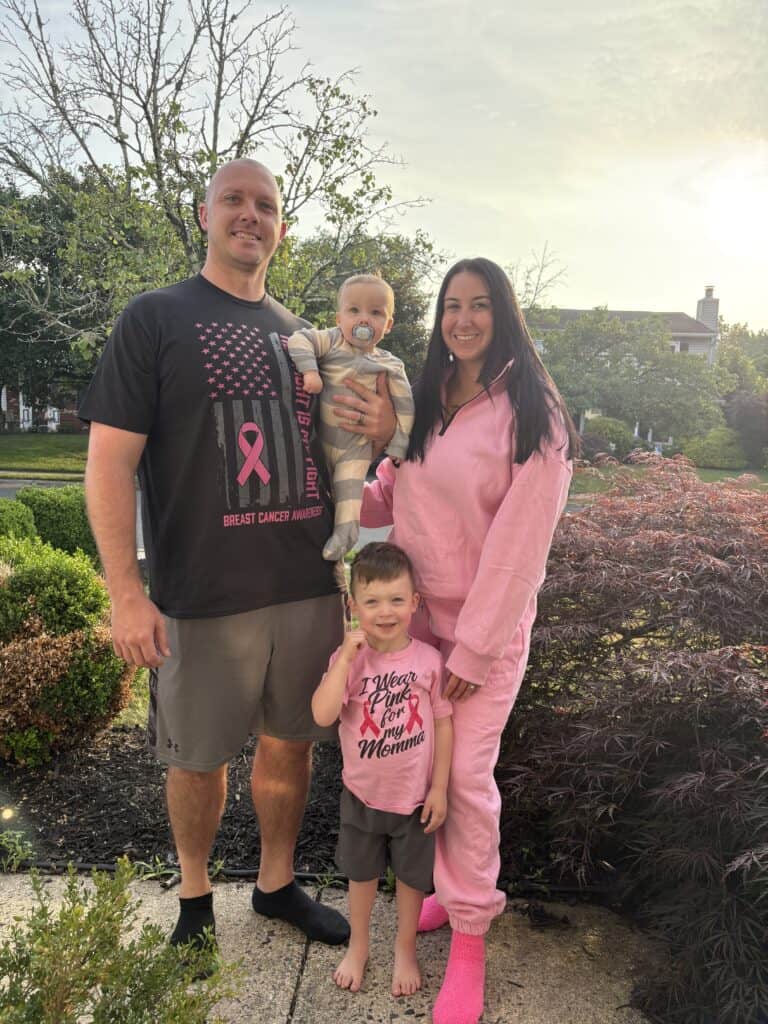
I’m grateful for how incredible my family and friends were during this time – my parents, my sister, my husband and my friends all stepped in to help with the boys and with everything else. My friends even drove from Pennsylvania and Maryland to visit me. My workplace was also incredibly supportive, and I was able to continue working throughout treatment.
Before starting treatment, I did IVF because I wanted the possibility of having more children someday. It was physically and emotionally difficult to fit fertility treatment into an already overwhelming diagnosis, but I am very grateful that I did it.
Learning to Advocate for Myself
One of the biggest things I’ve learned during this is to advocate for yourself. At one of my first appointments, they were preparing me for a port, but I asked whether I could receive chemotherapy through my veins instead. My sister had encouraged me to ask, and I figured the worst thing that could happen was that they would say no.
My doctors looked at my veins and agreed that we could try it. I was able to get through treatment without a port. I know that isn’t an option for everyone, but it taught me that it never hurts to ask questions and speak up about how you want your treatment journey to look. Everyone’s cancer experience is different, and you deserve to be part of those decisions.
A New Perspective
Today, I am finished with active treatment, although I’m still being monitored closely and dealing with some lingering side effects, including significant neuropathy and balance problems in my feet.
Breast cancer has completely changed my perspective on life. I don’t want to spend my time worrying about little things or putting off experiences because they seem too expensive or inconvenient. My kids are only little once, and life is not guaranteed. I’m more relaxed, goofier with my boys, and much less concerned about what other people think.
Breast Cancer Can Happen to Younger Women
Most importantly, I want other young women to know that breast cancer can happen even when you’re young, have no family history and don’t feel a lump. Knowing what is normal for your body matters. If something changes, speak up.
I also want people to know that a cancer diagnosis does not automatically mean your life is over. I thought it was the end of the world when I first learned I had breast cancer. Now I know that there can still be so much life on the other side of it.
Statements and opinions expressed are that of the individual and do not express the views or opinions of Susan G. Komen. This information is being provided for educational purposes only and is not to be construed as medical advice. Persons with breast cancer should consult their healthcare provider with specific questions or concerns about their treatment.