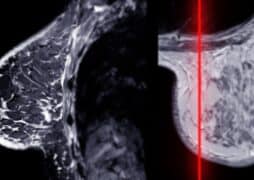
Triple negative breast cancer (TNBC) is an aggressive breast cancer that’s challenging to treat. Making up about 15-20% of all breast cancers, TNBC lacks three common tumor characteristics (biomarkers) that breast cancer treatments usually target: the estrogen receptor (ER), progesterone receptor (PR) and HER2 protein. Without these biomarkers, the cancer tests negative for all three, meaning it cannot be treated with standard hormonal therapies or HER2-targeted medications.
Because TNBC tumors tend to recur (come back) within the first five years and with limited treatment options, it’s a high priority focus for breast cancer researchers today. With funding, in part from Komen, researchers at the Lester and Sue Smith Breast Center at Baylor College of Medicine (BCOM) in Houston are exploring new ways to improve survival and quality of life for people living with both early-stage and metastatic TNBC.
Highlights of this work were the focus of the Komen-sponsored event, “Discovery Together: Translating Research into Lifesaving Impact,” which took place on Sat., May 16, at BCOM in Houston. The event included several promising research updates, as well as personal stories that illustrated the importance of patient advocacy in the breast cancer community.
Connecting Cutting-Edge Research to Life-Saving Clinical Care
While some tumors have identifiable biomarkers like ER+, PR+ or HER2+, and can be treated effectively with hormone therapy and targeted therapy drugs, TNBC is more difficult to treat. With fewer targeted treatment options, patients often receive the “kitchen sink” treatment, which can sometimes cause excessive side effects.
Today, researchers at the Breast Center are exploring several innovative approaches to more effectively treat early-stage and metastatic TNBC. Led by Xiang Zhang, Ph.D., former Komen Career Catalyst Research (CCR) grantee and Director of the Lester and Sue Smith Breast Center, members of the Breast Center research team shared how they are using new tools to fight tumors that resist standard treatments.
By studying the genetic traits of cancer cells and growing tiny tumor models in the lab, they can safely test new drugs for TNBC. The following are examples of this cutting-edge work that may one day help researchers find out which medicines will work best for people before their treatment even begins.
- Komen CCR grantee Na Zhao, Ph.D., is studying a protein called eIF4-A, which helps metastatic TNBC cells multiply and survive. In her presentation, “Targeting eIF4A to Combat Metastatic Triple Negative Breast Cancer,” Dr. Zhao shared her team’s current research in testing whether targeted drugs that block the eIF4-A protein can help treat advanced TNBC. Ultimately, Dr. Zhao hopes to test these protein-blocking drugs in future clinical trials to create better combination therapies and improve patient survival.
- Former Komen CCR grantee Kevin Roarty, Ph.D., and his team are studying why individual cancer cells within the same tumor adapt to different roles that help the cancer spread to other parts of the body and resist medical treatments. In his presentation, “Why Breast Cancer Spreads, and What We’re Doing to Stop It,” Dr. Roarty explained how a better understanding of how tumors behave and adapt could lead to new ways to stop metastasis earlier.
- Diego Pedroza, Ph.D., a researcher in the Komen-funded Rosen Lab, shared his team’s latest findings in his presentation “Chasing Metastatic Breast Cancer: How Understanding Mechanisms of Resistance Could Save More Lives.” Dr. Pedroza and his team’s research is focused on treating people with metastatic TNBC with specialized treatments that can help the body’s immune system recognize and eliminate metastatic cancer cells that are resistant to treatment.
- Jonathan Lei, Ph.D., shared how he and his team are using unique lab models called “patient avatars” to more accurately predict whether a tumor will respond well to a combination therapy vs. a single drug. Through his presentation, “How Precise is Precision Medicine? Rethinking How We Match Breast Cancer Treatments to Patients,” Dr. Lei explained that this insight could help doctors pinpoint the optimum amount of treatment for people before giving them more than they need, ensuring the best quality of life.
- In her presentation “Built to Resist, Broken to Respond: LIG1 Loss in TNBC,” Meenakshi Anurag, Ph.D., explained how a protein called LIG1 normally acts like a molecular “glue” to mend broken DNA inside cancer cells. When TNBC cells lose this glue, they are unable to repair themselves. Dr. Anurag’s lab is developing new tests to identify people that are missing LIG1 so that doctors can use targeted treatments to permanently break these cancer cells.
- Finally, Gloria Echeverria, Ph.D., shared exciting updates in her presentation, “New Therapeutic Opportunities for Targeting the Mitochondria in TNBC Beyond the Cell’s Powerhouse.” She explained that TNBC cells can resist chemotherapy by changing the shape of their mitochondria, which serve as the cell’s powerhouses. To prevent this resistance, her team is testing a drug combination that shuts down these altered mitochondria to help prevent the cancer from returning.
Sustaining the Lifeline of Innovation
Through these examples, researchers at the Lester and Sue Smith Breast Center clearly illustrate the lifesaving advances in clinical care that are possible with secure, ongoing financial support. The Center is home to the longest running National Cancer Institute (NCI) SPORE grant, which has provided millions of dollars to its researchers over the past 30 years.
Only through sustained funding can innovative ideas be transformed into lifesaving research. Komen is committed to doing everything we can so that no one dies of breast cancer, and research is key to finding new discoveries and treatments. Through the work of our Center for Public Policy (CPP), we actively push for strong state and federal funding across all areas of research. By expanding government funding and supporting increased diversity in clinical trials, we can ensure breakthrough medical advancements like these will reach every community.
Learn more about how the CPP is supporting advances in breast cancer research by signing up to be an Advocacy Insider.
Did you know?
Komen has invested more than $178 million in over 270 research grants and nearly 50 clinical trials focused on TNBC, with 75% of these grants focused on treatment.