
Here’s a guide to using artificial intelligence (AI) safely, especially when looking up information related to breast cancer.
Let’s imagine you open your pathology report and see a term you’ve never heard before, so you turn to AI for help defining it. The answer you get sounds clear and confident, but is it accurate? Is it up to date? Most importantly, is it right for you and your current situation?
Those considerations are important, whether you’re searching for general information about breast cancer risk, trying to figure out a test result or wondering if two medications can be taken together. Sure, AI can make complicated information easier to understand, but that does not always mean it is correct or complete. Here, we break down how these tools work, what they do well and perhaps not so well. Then we’ll conclude with how to use AI tools safely and efficiently, so you can get answers you can trust to help support your next steps forward.
“AI” or artificial intelligence is not just one thing
“AI” is an umbrella term that can refer to very different tools. Knowing which type you are using will help you judge the answer it gives you.
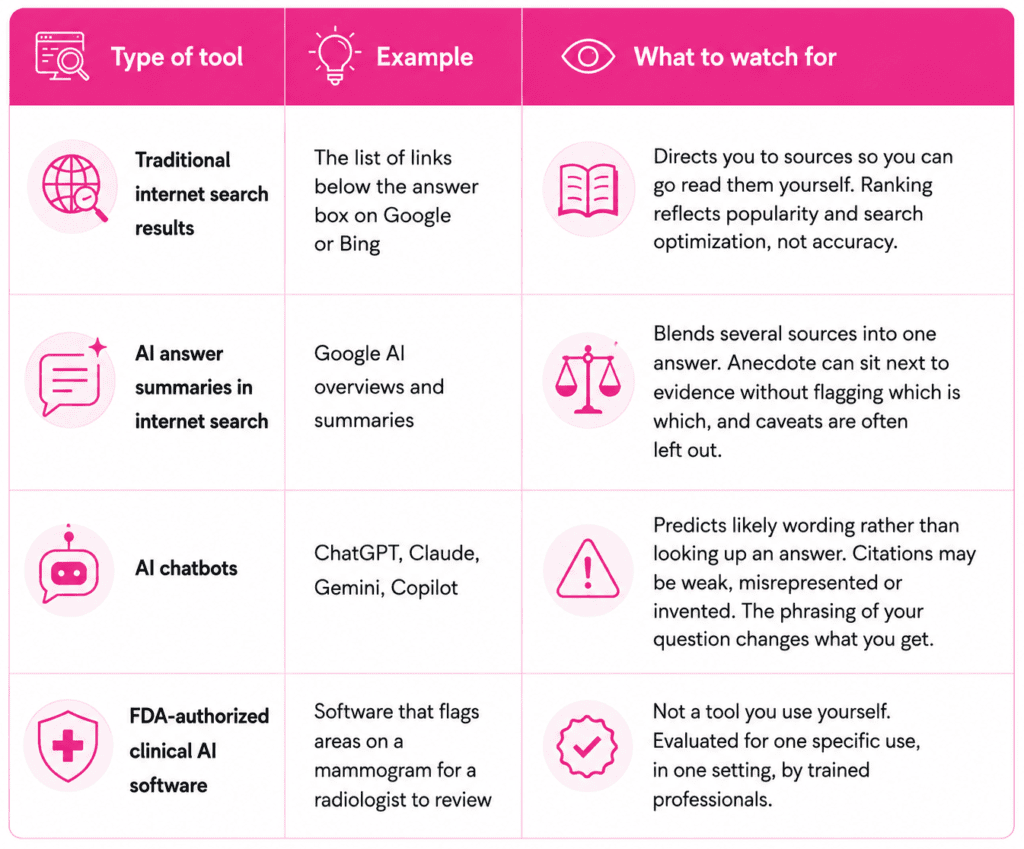
Importantly: Sources of information, privacy policies and the models themselves change constantly, so it’s not a matter of “Which AI tool is trustworthy?” Instead, it’s “How do I evaluate a tool I’m using and the answer that it just gave me?”
How does AI come up with an answer?
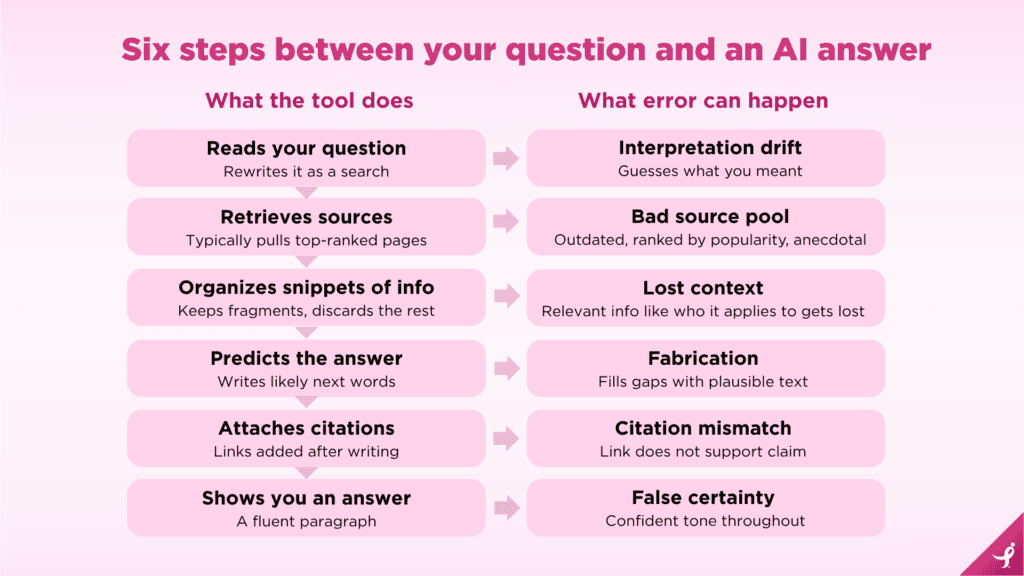
AI tools are trained on enormous amounts of text, learning which words, concepts and ideas tend to appear together. When you prompt one, it predicts what words should come next. It is not reasoning through your situation the way a person would.
AI does not understand your health, values or circumstances in the way that you or your health care team does. It can fill in details that are not real or make assumptions without telling you simply based on what common threads existed in the training data. This is one reason why different AI tools have different answers and are better or worse depending on the task. They have been trained on different information, follow different instructions or have access to different sources. Plus, the phrasing of the question alone can change the answer – which we will get to later in the guide.
At every step, there is an opportunity for error.
What an AI tool can do well and what it does poorly
AI is most useful for translating and organizing. It can turn a technical term into everyday language, organize your questions before an appointment or make a trusted health resource easier to read. Asking AI to summarize a current page from the Susan G. Komen website is a different task from asking an open-ended medical question and letting it draw on unknown sources.
Where it struggles is specificity and evidence. Answers tend to describe what is “typical” without accounting for your stage, biomarkers, past treatments, other conditions or preferences. Citations may be weak, misleading or invented. And because AI reflects the information it was trained on, answers can be less complete or accurate for people underrepresented in research or facing barriers to care.
Privacy and what to know before you paste (or attach)
Before you copy and paste personal information from your patient portal, pathology report or insurance paperwork – take a moment and protect your privacy.
HIPAA, or the Health Insurance Portability and Accountability Act, is a federal law that protects your health information when it’s handled by your doctor, hospital or health plan – but that protection doesn’t automatically extend to AI tools or apps. These things may follow different privacy rules than your doctor’s office or patient portal. Depending on the tool, what you type might be stored, reviewed or used in ways that you did not consent to.
Sharing too much information can increase your risk of scams or unwanted contact. For example, someone with access to your diagnosis, insurance information or contact details could send you a convincing fake bill or treatment offer that looks like it came from a trusted source. This is one reason to keep personal details out of general-purpose AI tools.

Even sharing treatment dates, age, location or test results could be combined to identify you, even without your name. That’s why it’s a good idea to pause and do your research before inputting any of your data into an AI tool. Read more examples of what not to upload in the AI Tool Checklist.
Better prompts get better answers
A stronger prompt means clearer instructions that guide more complete and supported answers. It does not guarantee the answer is correct, but it can help give you more useful answers that are easier to check. A solid prompt includes five parts: task, context, boundaries, sources and format.
When asking about breast cancer information, tell the tool what you want it to do, include some context without risking privacy, set boundaries such as “do not recommend treatments,” ask it to use and point out trusted sources and request a simple format like a checklist or table. Read a further breakdown with examples in our AI Tool Checklist.
How to verify an answer from an AI tool
Instead of asking whether the entire product is trustworthy, ask yourself:
- What type of answer was provided?
- Was the information it searched for current?
- Were the sources of that information identified and legitimate?
- Can you be sure those sources support the answer?
When the answer you receive points out the sources (as you requested) – be sure to check them. Stronger answers will come from established and well-trusted sources like academic medical centers, peer-reviewed journals, established clinical guidelines or recognized cancer organizations, like Susan G. Komen. Even then, verify the link goes where it claims. Some lead to a home page for a study that never existed. Others can be real but misrepresented with findings overstated or context dropped. A citation is a good starting point but always confirm that it supports what the AI claims.
It’s also useful to check the date a source was published or last updated since information for treatment guidelines and clinical trials change over time. You can always ask in the prompt for the answer to clearly separate established information from emerging research. Compare the answer with more than one trusted source. Is the topic discussed in a similar way, or do sources disagree or discuss it more cautiously? That can give you an idea of the certainty of a claim. Importantly, put it into context. If the answer could affect your health, treatment, medications, symptoms or next steps, bring it to your health care team.
Check out our verification checklist in our resource below.
Why Susan G. Komen is a trusted resource
Susan G. Komen’s educational content is developed through an evidence-based review process. The content is based on research in peer-reviewed publications and established clinical practice guidelines, with review and input from experts in the field, as well as patient advocates. Komen blogs like this one, refer back to Komen.org’s “About Breast Cancer” section, also known as the “ABCs,” which serves as the educational backbone of frequently updated, evidence-based breast cancer information.
Before relying on an AI tool for an answer, be sure to:
- Ask clearly
- Check carefully
- Protect your privacy
- Discuss information with your health care team.
Use AI to prepare for the conversation, not to replace it
Your care team is your best source of expert guidance. You might use AI to help you walk into an appointment more prepared. It may help organize your thoughts or make terms easier to understand, but your health care team should answer the questions that require medical judgment. They can answer your questions in the full context of your care, background and preferences. You can also get personalized guidance from a patient navigator from Komen’s Patient Care Center.
If you’re interested in learning the latest news about how AI is being integrated into breast cancer research and care, be sure to check out our upcoming installment of Breast Cancer Breakthroughs premiering on August 27.
Content covered in the Know More Educational Series may be an emerging area in research or technology. Talk with your doctor about what is right for you.
We’d love your thoughts! Take our brief survey here.
Browse the rest of the Know More series here.
Explore More
- Learn more about how to use AI to find a clinical trial
- Read: Why Susan G Komen is a trusted source for health information
- Listen to the Real Pink Podcast: Leveraging AI in Breast Cancer Research
- Video webinar – Komen EmpowerED: AI+ Breast Cancer Care
- Video and blog – Breast Cancer Breakthroughs Episode 23: Artificial Intelligence (AI) in Breast Cancer Research & Care
- Real Pink Podcast – Real Talk: Can AI Improve Breast Heath Care?
- Real Pink Podcast – Leveraging AI in Breast Cancer Care
- Spotlight on Clinical Trials Blog – Can AI (Artificial Intelligence) Help You Find the Right Breast Cancer Clinical Trial?
- Under the Microscope video – What Is AI and How Is It Impacting Breast Cancer?
AI Toolbox Quiz
You’ve just learned about different types of AI tools, how they come up with answers, keeping your data private and how to check whether a source holds up. Take this quiz and see if your knowledge can pass a fact-check!