
Each year, the American Society of Clinical Oncology (ASCO) Annual Meeting offers new hope to the breast cancer community by showcasing the latest advances in breast cancer research and clinical care. Today, we are shining a spotlight on the top breast cancer clinical trials featured at ASCO. As researchers, health care professionals, advocates and patients from around the world gather in one place to network and discuss the latest breakthroughs, at the heart of these exciting advances are clinical trials.
From new targeted therapies and antibody-drug conjugates to innovative approaches like monitoring tumor resistance through blood tests, these studies continue to expand options for many who are facing difficult diagnoses. Below are some of the top clinical trials featured at ASCO that address the unmet needs of this diverse community, from early breast cancer to metastatic disease.
Smarter Interventions for Early Breast Cancer
- Researchers of the phase 3 OPTIMA clinical trial shared that some women with high-risk, early ER-positive (ER+), HER2-negative (HER2-) breast cancer may be able to safely avoid chemotherapy. The OPTIMA trial looked at breast cancer patients whose tumors were larger or had spread to up to nine lymph nodes. In the past, these patients almost always received chemotherapy because doctors worried the cancer was likely to come back. By using a genomic test called Prosigna, which analyzes 50 genes to determine the likelihood of recurrence, researchers found that nearly seve nout of 10 patients could safely avoid chemotherapy entirely.
- The latest results of the lidERA breast cancer study (NCT04961996) provided good news for people with early ER+, HER2- breast cancer, who currently rely on standard hormonal therapies like tamoxifen or aromatase inhibitors after surgery to reduce the risk of their cancer coming back. The lidERA study evaluated a new oral selective estrogen receptor degrader (SERD) called giredestrant, and results showed the drug reduced the risk of recurrence or death by 30% while lowering the chance of metastasis to other parts of the body by 31%. Importantly, results were similar between pre- and postmenopausal women. Study participants also found the side effects of giredestrant, like hot flashes and joint pain, to be tolerable enough to stay on the medication without risk of stopping.
Better Outcomes for People Living with Advanced or Metastatic Triple Negative Breast Cancer
- Sacituzumab govitecan is an antibody-drug conjugate (ADC) that has proven to be an effective treatment for people with advanced or metastatic triple negative breast cancer (TNBC) whose disease has previously been treated. But researchers are now asking, could it also be an effective first-line treatment for these patients? The ASCENT-03 (NCT05382299) clinical trial is investigating whether sacituzumab govitecan is a better first-line treatment option than chemotherapy for people with advanced or metastatic TNBC who are not eligible for immunotherapy. Researchers found that using sacituzumab govitecan in place of chemotherapy allowed participants to remain on their subsequent treatment longer.
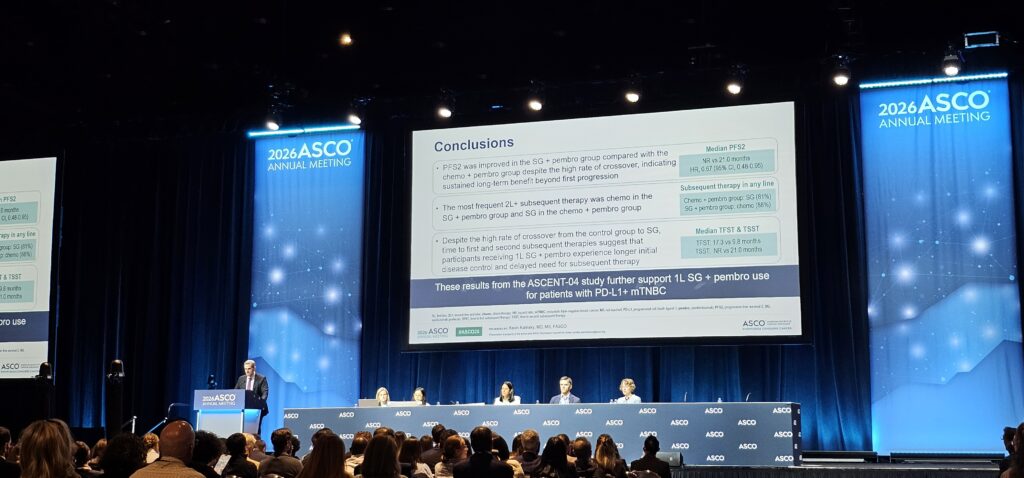
- The ASCENT-04 clinical trial (NCT05382286) also evaluated people with advanced or metastatic TNBC, but these participants could receive immunotherapy, and their regular first-line treatment included a combination of chemotherapy and an immunotherapy called pembrolizumab. Like the ASCENT-03 study, researchers found that when they replaced the chemotherapy part of the treatment with sacituzumab govitecan, participants were able to remain on their subsequent treatment longer.
- The phase 3 PANKU-Breast02 clinical trial (NCT06382142) found that an ADC called izalontamab brengitecan (iza-bren) significantly improves overall and progression-free survival compared to chemotherapy in people living with advanced or metastatic TNBC, who were previously treated. Results of the PANKU-Breast02 study showed that those taking iza-bren had a median overall survival of 15.9 months versus 12.5 months for those who were treated with chemotherapy. These exciting results show that those taking iza-bren had longer overall survival, longer time without their cancer coming back and a higher response rate to treatment than chemotherapy.
Progress for Advanced or Metastatic HR+ Breast Cancer
- Results from the phase 3 VIKTORIA-1 clinical trial (NCT05501886) show that gedatolisib, combined with fulvestrant, with or without palbociclib, cut the risk of cancer progression or death by half for people living with advanced or metastatic HR+, HER2- breast cancer. Participants who received the experimental combinations experienced a median progression-free survival of 11.1 to 11.3 months, which was roughly double the 5.6 months found using standard treatments.
- Researchers of the phase 3 SERENA-6 clinical trial (NCT04964934) are seeking new ways to advance care for people living with advanced or metastatic HR+, HER2- breast cancer. By detecting ESR1 mutations using ctDNA (small fragments of cancer DNA in blood), researchers have found that they can improve outcomes by switching participants from a first-line treatment of an aromatase inhibitor plus a CDK4/6 inhibitor to treatment with the oral SERD camizestrant. The SERENA-6 study found that participants who switched to camizestrant after developing an ESR1 mutation lived significantly longer without their cancer progressing on their first and second lines of treatment than those who continued using standard therapy.
New Strategies with Lifestyle Interventions for Quality of Life and Breast Cancer Risk
- Not every promising advancement in breast cancer research has to be a drug. The phase 3, randomized Breast Cancer Weight Loss (BWEL) clinical trial (NCT02750826) is investigating whether a two-year, telephone-based weight loss and exercise intervention can significantly improve physical function and quality of life for women with early breast cancer. At this year’s ASCO meeting, early results from a sub-study of BWEL were presented that included promising results for 542 participants with stage 2 to 3 breast cancer and a minimum BMI of 27. In just six months, these participants receiving the weight loss intervention saw improvements in their overall physical and mental health, as well as social activities.
- Could weight loss drugs like glucagon-like peptide-1 receptor agonists (GLP-1) treatments be used to lower breast cancer incidence? In a large observational study, a group of over 100,000 women between the ages of 45 and 80 received GLP-1 medications and were found to be around 30% less likely to develop breast cancer than those who did not receive them. These results were independent of age, race, ethnicity, BMI, breast density and diabetes. While these initial findings are promising, more randomized trials are needed to explore the true impact that GLP-1 medications have on breast cancer.
While not every clinical trial leads to an immediate change in treatment, the collective discoveries presented at ASCO represent meaningful steps forward for researchers and the greater breast cancer community. Thanks to the ongoing advances that come from clinical trials, patients have access to better treatments, improved quality of life and survival, and most importantly, hope that a world where no one dies from breast cancer is within reach.
Talk with your doctor to learn more about these findings from ASCO, or other clinical trials available in your area. You can also learn more about clinical trials on Komen.org.
Read about the Five Truths About Breast Cancer Clinical Trials.
If you or a loved one needs information or resources about clinical trials, please call our Breast Care Helpline at 1-877 GO KOMEN (1-877-465-6636) or email clinicaltrialinfo@komen.org to connect with a trained specialist.
Take our brief survey and browse the rest of the Spotlight on Clinical Trials series here.