In honor of National Breast Cancer Awareness Month (NBCAM), this special edition episode of Breast Cancer Breakthroughs focuses on the progress achieved since the launch of this series in 2023. We revisit expert interviews to highlight the clinical trials that have led to recent FDA approvals and look ahead at the breakthroughs we envision for the future.
The Impact of Breast Cancer
We’ve seen the pace of breast cancer treatment options accelerate over time, with more than half of all modern targeted drug classes introduced in the last decade. As a result of both treatment advancements and early detection, the female breast cancer death rate, which was at its peak in 1989, dropped 44% by 2023.
Despite this progress, estimates show that there will still be nearly 43,000 breast cancer deaths in the U.S. this year alone.
“I don’t want anybody else to go through this,” said Michelle Beck, breast cancer advocate. “I don’t want future generations to go through what I did, watching my grandmother pass away from metastatic breast cancer (MBC) and then myself, having [breast cancer] twice.”
Fortunately, scientists, clinicians, patient advocates, research-funding organizations and the pharmaceutical industry are pursuing new ways to tackle breast cancer by improving care through discovery.
FDA Approvals for Breast Cancer Treatment Since 2023
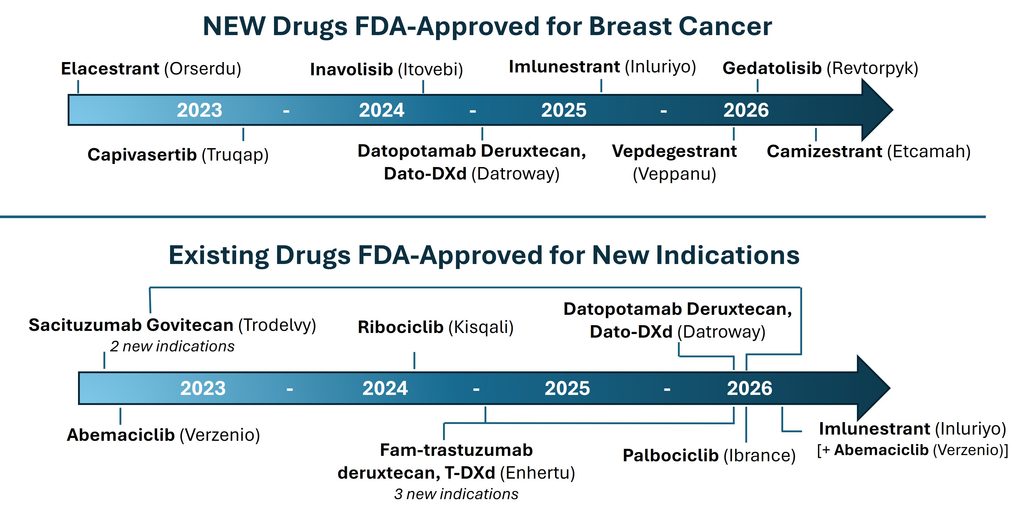
Since we launched the Breast Cancer Breakthroughs series in 2023, there have been eight new drugs FDA-approved to treat breast cancer and seven existing drugs have received FDA approvals for new indications, meaning they can be used in additional breast cancer patient populations and/or in new treatment settings.
While the number of FDA-approvals is impressive, a key feature of these treatments is that they are designed to specifically target cancer cells while minimizing damage to normal/healthy cells. As a result, they are generally better tolerated (have less severe treatment-related side effects) than traditional chemotherapy.
Recent FDA-approvals focus on *four major drug types:
- Antibody-Drug Conjugates (ADCs): Scientists have uncovered the power of linking an antibody (the targeting agent) with cancer killing chemotherapy, resulting in ADCs. Since 2023, we’ve observed rapid expansion of the use of ADCs, including one new FDA-approved ADC called datopotamab-deruxtecan or Dato-DXd. These targeted cancer-killing drugs have become available to even more breast cancer patients over the past three years, with FDA-approvals leading to new indications for three ADCs (fam-trastuzumab deruxtecan, sacituzumab govitecan, and datopotamab-deruxtecan). We anticipate this trend to continue as we head into the future.
- PI3K Pathway Inhibitors: Since 2023, three new drugs that target the PI3 kinase pathway have been FDA-approved for treating hormone receptor-positive (HR+), HER2-negative metastatic breast cancer (MBC). These new treatments include capivasertib, inavolisib and gedatolisib. Since overactivation of the PI3K pathway is often associated with treatment resistance, the discovery of new drugs that target this pathway should help prevent breast cancer progression and improve outcomes for many patients.
- Expanding Use of CDK4/6 Inhibitors: CDK4/6 inhibitors work by putting the brakes on cell division (cancer cell growth) and are often combined with hormone therapies to delay progression of HR+ breast cancer. While no new CDK4/6 inhibitors have been FDA-approved since 2023, we observed new indications FDA-approved for three existing drugs (abemaciclib, ribociclib and palbociclib).
- Hormone Therapies: Since 2023, there have been four new oral hormone (endocrine) therapies FDA-approved to treat HR+, HER2-, ESR1-mutant MBC. These drugs include oral SERDs, elacestrant, imlunestrant and camizestrant, along with the oral PROTAC, vepdegestrant. Most recently, imlunestrant also received an FDA approval for a new indication. Many individuals with HR+, HER2- MBC develop ESR1 gene mutations, which lead to treatment resistance and disease progression. These new hormone therapies are not only easier to take, as oral medications, but they provide additional therapeutic options if patients progress on first-line treatment. Interestingly, the oral SERD camizestrant is also the first FDA approval in breast cancer based on circulating-tumor DNA (ctDNA) monitoring.
*Latest FDA approval (Oct. 7, 2026) not included above: Tucatinib in combination with trastuzumab and pertuzumab for the maintenance treatment of patients with unresectable locally advanced or metastatic HER2+ breast cancer.
Impact on Patients and What’s Next?
While the growing number of treatment options is a significant benefit for patients, effective therapies that maintain quality of life are even more meaningful.
“I think most of us in the metastatic community would be happy if we could live close to a normal lifespan with treatments that allow us to live and not just exist, i.e. treatments that have fewer side effects,” said METAvivor President Kelly Shanahan, M.D., who has been living with MBC since 2013. “For me, that’s the holy grail.” The future of breast cancer care appears increasingly focused on making that vision a reality.
Beyond efforts to develop more selective, better-tolerated treatments, the next phase of research will likely focus on moving new treatments into earlier-stage disease and earlier lines of treatment. Efforts to identify the most effective sequencing of therapies (order in which they are given) and evaluate treatment combinations are also expected to continue. Additionally, ctDNA-guided treatment strategies will likely play an increasingly important role in the management of breast cancer.
To learn more about the future of breast cancer research, check out the Top Four Breast Cancer Research Trends to Watch in 2026.
Subscribe to Komen’s YouTube channel to stay informed about future episodes of Breast Cancer Breakthroughs, where we will delve into the most exciting advances in breast cancer treatment and technology coming soon for patients.
Content covered in the Breast Cancer Breakthroughs educational series may be an emerging area in research or technology. This information is being provided for educational purposes only and is not to be construed as medical advice. Talk to your physician when deciding what is right for you.
Breast cancer can bring questions you never expected to have — and moments when you simply need someone to listen. Komen’s Breast Care Helpline connects you with trained, caring staff who are here to listen, answer questions and help you find the information, resources and support you need. Call 1-877 GO KOMEN (1-877-465-6636) Monday–Thursday, 9 a.m.–7 p.m. ET, and Friday, 9 a.m.–6 p.m. ET, or email helpline@komen.org. Se habla Español.
For more information on clinical trials or if you need support as you go through treatment, the Komen Patient Care Center can help.
Find a clinical trial.
Take this survey to let us know what you think of this content as part of the Breast Cancer Breakthroughs Series.
Breast Cancer Breakthroughs is possible thanks to our series sponsors: