
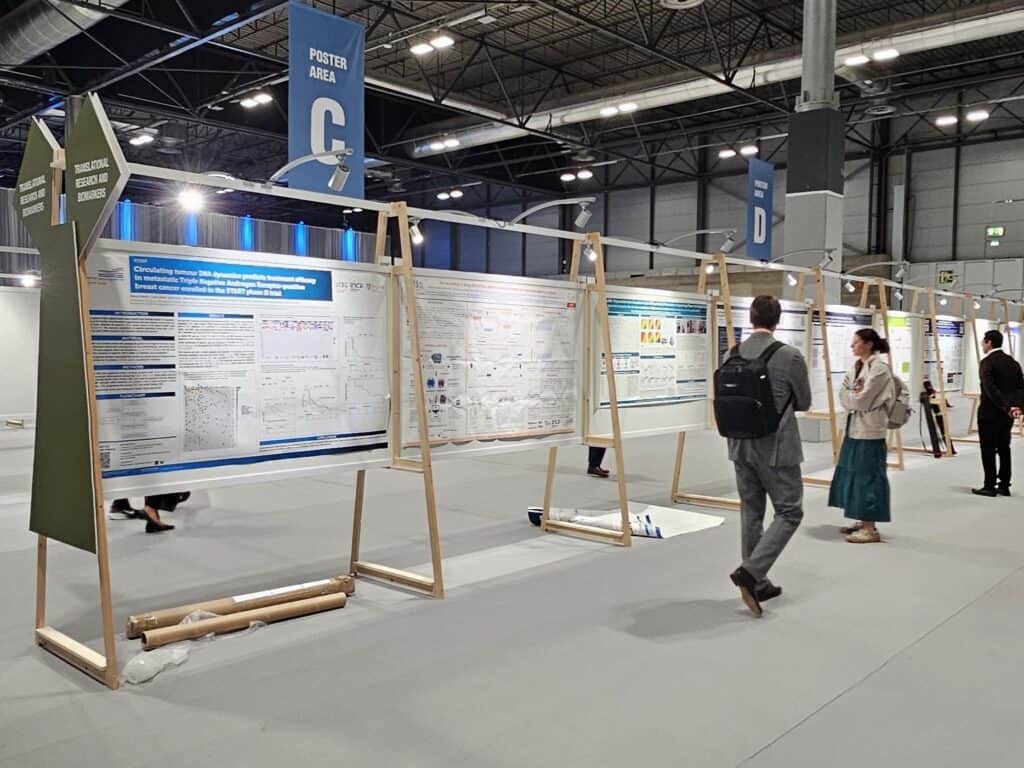
At the European Society for Medical Oncology (ESMO) Congress 2026, experts addressed five outstanding questions in breast cancer research, paving the ever-growing path to more personalized care. Last year’s ESMO Congress delivered a wave of phase 3 clinical trial results, and this year thousands of experts gathered in Madrid with more answers from many of the same studies with questions beyond “does this treatment work?” Instead, questions like “when can this treatment be given for the best outcome?” And, “which patients will benefit the most?”.
In early breast cancer news, we saw researchers looking at the balance between the optimal amount of treatment to reduce the risk of recurrence while evaluating who may be able to safely receive less intensive treatment. For metastatic breast cancer (MBC), a growing number of options raises a new challenge: figuring out what treatment to use and in what order.
Metastatic breast cancer highlights
1. What’s next for ADCs?
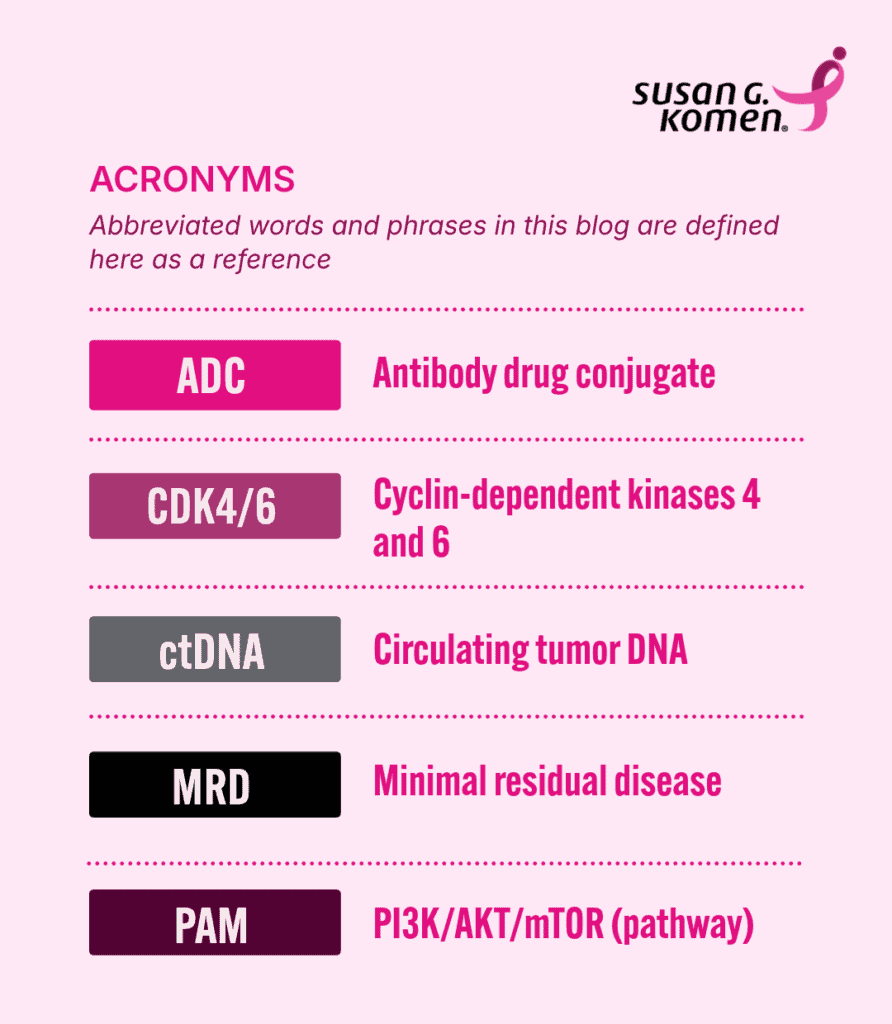
Antibody drug conjugates (or ADCs) combine an antibody that targets cancer cells with a cancer-killing drug, called a payload (typically a chemotherapy). One question that researchers are looking to answer is, is it effective to use one ADC after another if they have the same type of payload? In the SWITCH study, when cancer had progressed while on one ADC, switching to another with a new target but with the same type of payload shrank tumors in only 0-8% of people.
There were also several phase 3 clinical trial readouts testing new (not yet FDA-approved) ADCs across the spectrum of metastatic breast cancer including HR+/HER2-, HER2-low and triple negative breast cancer (TNBC). In one study, participants who received the ADC sacituzumab tirumotecan lived longer than those who received chemotherapy.
Collectively, we are seeing that as more ADCs become available, choosing the right drug and in the right order could improve how well it works, but more research is needed.
2. After a CDK4/6 inhibitor stops working, what comes next?
Hormone receptor-positive(HR+), HER2-negative (HER2-) MBC is initially treated with hormone therapy and a CDK4/6 inhibitor; however, the cancer can eventually become resistant and begin to grow again. Studies are testing several options using biomarker testing to guide the next step in a treatment plan.
CDK4/6 inhibitors target cell machinery involved in cell growth, and after cancers start to get around that, one approach is to target the same machinery but with a different CDK4/6 inhibitor. A newer drug, atirmociclib, blocks only CDK4 with the goal to avoid low blood cell counts. In the phase 2 FOURLIGHT-1 trial, the CDK4 delayed cancer growth (a median of 9.4 vs. 6.6 months), as a result, a phase 3 trial is underway.
Another way cancer cells develop resistance to first-line treatment is by activating the PI3K/AKT/mTOR (PAM) pathway, which promotes cell survival and growth. The VIKTORIA-1 trial tested a new PAM pathway inhibitor called gedatolisib. Updates from this trial found that gedatolisib in combination with fulvestrant (hormone therapy) and/or palbociclib (CDK4/6 inhibitor) nearly doubled the time before cancer grew in people with PIK3CA mutations in their tumor compared to another approved drug that targets the PAM pathway.
These studies are helping to clarify which pathways are the most useful to target after resistance develops.
3. Can treatment reach breast cancer that spreads to the brain (brain metastases)?
Options for treating brain metastasis is a major unmet need, particularly for those with HER2-positive (HER2+) and TNBC. In small exploratory analyses of people with brain metastases who participated in large phase 3 trials, the ADC trastuzumab deruxtecan (T-DXd) plus pertuzumab (HER2-targeted therapy) and the ADC datopotamab deruxtecan controlled cancer in the brain longer than standard treatment in HER2+ and TNBC respectively.
The BRIDGET trial found that adding the pill tucatinib after radiation for HER2+ MBC that grew only in the brain kept it at bay for over 18 months in more than half of the study group. INSPIRE-LM reported that delivering HER2-targeted treatment into the spinal fluid of a small group with HER2+ cancer that spread to the lining of the brain and spinal cord led to a median survival of about three years.

Early breast cancer highlights
4. How much treatment is enough for early breast cancer?
When diagnosed with early breast cancer, the treatment goal is to eliminate the cancer and reduce the risk that it returns (recurrence). However, reducing this risk needs to be balanced against side effects and how it impacts one’s quality of life – especially for HR+ breast cancer, which involves taking hormone therapy for 5-10 years. Some long-term studies helped clarify the trade-offs. Final results from NSABP B-42 saw that five extra years of the hormone therapy letrozole modestly lowered the chance of breast cancer returning over 15 years (about 15 in 100 vs. 18 in 100 people), and it did not help people live longer.
In the phase 3 NATALEE trial, the longer-term data looked at whether adding the CDK4/6 inhibitor ribociclib to hormone therapy for three years could provide benefits lasting after treatment ends. After six years, more people had no evidence of disease (83% vs. 78%) with slightly more people alive (92% vs 90%), but this analysis wasn’t designed to formally test survival benefit.
5. Can blood tests help personalize care?
Blood tests that examine circulating tumor DNA (ctDNA) may help monitor the presence of cancer cells, also known as minimal residual disease (MRD). In the JCOG1204A1 study, people with high-risk early breast cancer had their ctDNA tested after surgery, and those with ongoing negative test results almost never had their cancer come back in the five years observed so far. When the test was positive, it flagged recurrence about seven months before a scan picked it up or symptoms occurred. Whether acting earlier helps people live longer is not yet known.
Early results from B-STRONGER-1 suggest that ctDNA may also show how well treatment before surgery is working for early TNBC. Before treatment started (which typically consists of chemotherapy and immunotherapy before surgery that helps shrink the tumor) ctDNA was found using a very sensitive test in 96% of the participants. About 4 out of 5 people cleared it, with no ctDNA detected after the first two cycles of treatment. Those who cleared the ctDNA early were more likely to have no cancer found at surgery. More studies will determine if this test can help personalize treatment.
Progress continues
Research presented at conferences like ESMO continue to refine questions that can help improve cancer care. Talk with your care team about if any of these findings may apply to you, including whether a clinical trial is right for you. Keep following us for additional research updates being announced at the 2026 San Antonio Breast Cancer Symposium in December, the world’s largest breast cancer conference.
Questions? Call our Patient Care Center at 1-877 GO KOMEN (1-877-465-6636).
Content covered in the Know More Educational Series may be an emerging area in research or technology. Talk with your doctor about what is right for you.
We’d love your thoughts!
Take our brief survey and browse the rest of the Know More series here.
Explore more resources:
Top Four Breast Cancer Research Trends to Watch in 2026
Breast Cancer Breakthroughs Episode 24: Special NBCAM Edition – Improving Care Through Discovery
Breast Cancer Breakthroughs Episode 16: On the Horizon of PI3K Pathway Inhibition
Four Things to Know About Clinical Trials
Anti-body Drug Conjugates – What Do They Mean for Patients?
Hormone Receptor-Positive Breast Cancer: Why Your HR Status Matters
Understanding Metastasis and Four Ways to Take Charge of MBC